Monday, August 12, 2013

GLOBAL VOLCANISM: The Global Volcano Report For August 2, 2013 - Updates On Etna, Tjörnes Fracture Zone, Avachinsky, And Yellowstone!

August 02, 2013 - WORLDWIDE VOLCANOES - The following constitutes the new activity, unrest and ongoing reports of volcanoes across the globe.
Mount Etna.


Etna (Sicily, Italy): A cluster of earthquakes of magnitudes 2-3 occurred yesterday under the eastern flank near Sant Alfio, at depths around 7-8 km.


Tjörnes Fracture Zone (North of Iceland): A (probably tectonic) swarm of earthquakes has been occurring since yesterday in the eastern part of the TFZ, about 10-15 km north of the shore at various depths mostly below 15 km. 

Location of recent quakes at the TFZ.

It includes more than 100 quakes yesterday including 6 above magnitude 3 (up to 3.8 yesterday morning).


Avachinsky (Kamchatka): A (so far small) seismic crisis has started about a week ago. The earthquake hypocenters are currently located at depths around 30 km SE of the volcano.

Location of recent quakes under Avachinsky (blue dots) (EMSD).

The new quakes superimpose to the normal seismic activity at shallow depth. It is not clear whether this indicates that magma has started to accumulate at the mantle-crust boundary beneath the volcano, or whether the seismic activity there is purely tectonic and related to the subduction of the Pacific Plate... [read more]


Yellowstone (Wyoming, USA): The famous Steamboat Geyser erupted again during the past night breaking a 8 years period of dormancy. Known as the currently largest geyser in the world, its jets are known to reach up to 90 m height.

It is located in the Norris Basis in the northern part of Yellowstone. Its eruptions are very irregular, with intervals ranging between several weeks (29 eruptions in 1964) to decades (record was 50 years pause with no eruption). 

Sunday, August 11, 2013

EXTREME WEATHER: Complex Of Severe Earth Changes In The United States And Europe - Severe Storm, Flooding Risk From Omaha To St. Louis And Oppressive Heat Bakes Much Of Europe!

August 02, 2013 - UNITED STATES & EUROPE - Here are two reports from AccuWeather, illustrating the extreme weather taking place on either side of the Atlantic Ocean.
Severe Storm, Flooding Risk From Omaha To St. Louis.


A series of thunderstorms will continue to roll along over the central Plains, and some areas will be hit with severe weather into Saturday.

As one complex of storms that brought severe weather to Nebraska Thursday evening weakens over Missouri, a new batch of storms was already bringing severe weather to parts of South Dakota on Friday morning.

This new complex of storms will roll southeastward into Saturday across Nebraska, Missouri and parts of Kansas and Iowa. The storms could reach as far as Tennessee, northern Mississippi and Alabama later Saturday.

Cities and suburbs from Omaha, Neb., to Kansas City and St. Louis, Mo., are most likely have disruptive and damaging storms.

While frequent lightning strikes and hail will hit some communities hard, the greatest threat from the storms is damaging wind gusts and flash flooding.

Motorists should expect delays along I-29, I-70 and I-80 in the region, due to localized blinding downpours and excess water on the road surface.

For a few locations, this will be the second round in as many days of strong to severe thunderstorms, including parts of South Dakota, Nebraska and Kansas.

Much of the new rain falling on top of saturated ground will just run off into streams and rivers. People in unprotected, low-lying areas that are prone to flooding should keep a watchful eye.

Never drive across flooded roadways, as only about a foot of water can cause your vehicle to loose traction and could be swept downstream.

The rain is not unwanted in some areas. Portions of Iowa, for example, have had less than 25 percent of their normal rainfall during July.


Areas from western Nebraska southward to West Texas over the High Plains are in great need of rain. Much of this area is in extreme to exceptional drought. The storms into Saturday will avoid much of the drought areas over the High Plains.

Another complex of storms may fire farther south Saturday night and Sunday, beginning over parts of Kansas.

The storms are firing along shifting boundary between unusually cool air over the Midwest and 100-degree heat over much of Texas.

Interestingly, one of the disturbances producing the rounds of thunderstorms over the Plains has a chance at surviving a trip to the Gulf of Mexico early next week. Once in a while, such disturbances can develop into a tropical system.

Oppressive Heat Bakes Much Of Europe.

August got off to a scorching start across much of central and western Europe. A blast of hot air spread across the region allowing temperatures to soar into the mid- and upper 30s Celsius.

The hot spell preceded a storm system moving into the northern United Kingdom. Ahead of this storm, a flow of hot air from the south made for a very uncomfortable Thursday and Friday in many places.

A smattering of oppressively hot temperature observations include 35C (95F) in Rome, 34 in London, 33 in Frankfurt and 38 (101F) in Madrid.

While cooler weather pressed into England Friday, the heat was still on in central Europe. Florence, Italy climbed to 37C (99F) late in the afternoon while Frankfurt topped out near 35C.

This excessive heat continued the trend of a warm last month in much of Europe. Since July 1, locations such as London, Paris and Madrid have all averaged at least 2.8 degrees Celsius (5F) above normal.

Thankfully, a break from the heat is on the way for western Europe this weekend and into next week. Cooler air will filter into the region from the northern Atlantic and bring temperatures much closer to average.

While the western part of the continent cools, the core of the heat will shift eastward to include Hungary, Slovakia, Slovenia and Croatia. Southern Spain as well as Italy will also remain quite warm.

Saturday, August 10, 2013

Two studies use phrase “10 times faster” to describe climate changes

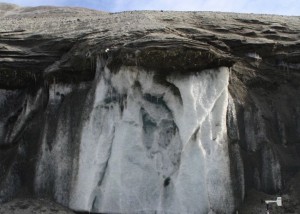
Meltwater in Antarctica via Joseph Levy
Climate warming happening 10 times faster than in the past 65 million years. Antarctic permafrost melting 10 times faster than in 11,000 years,

Via earthsky.org, 2 August 2013 (Thanks Connie) - Two recent studies suggest that the climate warming occurring on Earth today is happening at a dramatically fast rate. It’s this rate of change, scientists say – the speed with which average global temperatures are expected to climb over the coming decades – that will make the ongoing climate warming troublesome for living things on Earth. Both groups of scientists used the phrase “10 times faster” to describe climate changes.

One study, from Stanford University, suggests that climate change is happening 10 times faster than it has at any time in the past 65 million years. The other study, from the University of Texas, suggests that Antarctic permafrost is now melting 10 times faster than in 11,000 years, adding further evidence that Earth’s Antarctic is, in fact, warming just as Earth’s Arctic is. Click the links below to learn more about these studies.
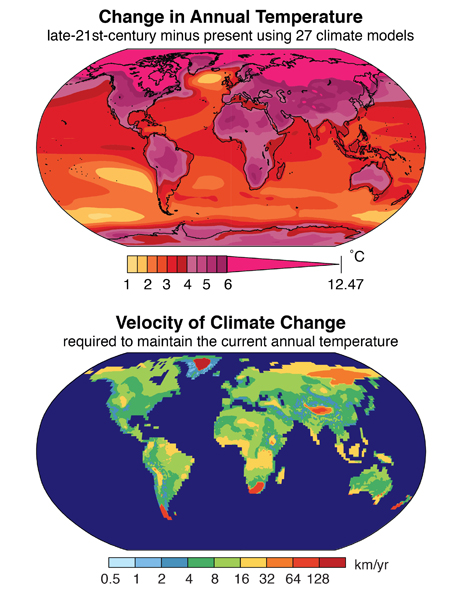
The top map shows global temperatures in the late 21st century, based on current warming trends. The bottom map illustrates the velocity of climate change, or how far species in any given area will need to migrate by the end of the 21st century to experience climate similar to present.   Images via Stanford University.
The top map shows global temperatures in the late 21st century, based on current warming trends. The bottom map illustrates the velocity of climate change, or how far species in any given area will need to migrate by the end of the 21st century to experience climate similar to present. 

Climate warming 10 times faster than in 65 million years. In a study announced August 1, 2013, Stanford University climate scientists say that Earth is undergoing one of the largest climate changes in the past 65 million years. They say, moreover, that the change is currently on pace to occur at a rate 10 times faster than any change in 65 million years. Without intervention, these scientists say that this extreme pace could lead to a 5-6 degree Celsius spike in annual temperatures by the end of this century.

Noah Diffenbaugh and Chris Field, both senior fellows at the Stanford Woods Institute for the Environment, published these results as part of a special report on climate change in the August 2013 issue of Science. They conducted a “targeted but broad” review of scientific literature on aspects of climate change that can affect ecosystems, and they investigated how recent observations and projections for climate change in the coming century compare to past events in Earth’s history.

For instance, they compare the current warming to the 5-degree-Celsius temperature hike that occurred 20,000 years ago, as Earth emerged from the last ice age. They say that change was:

… comparable to the high-end of the projections for warming over the 20th and 21st centuries.

The difference is that, at the end of the last ice age, the warming took place over thousands of years. The same warming now is expected to occur over decades. Diffenbaugh and Field note that, as the climate warmed at the end of the last ice age, plants and animals moved northward to cooler climates. Similar (but possibly less successful?) migrations are expected in the coming years.

Diffenbaugh and Field also say in their press release that:

… some of the strongest evidence for how the global climate system responds to high levels of carbon dioxide comes from paleoclimate studies. Fifty-five million years ago, carbon dioxide in the atmosphere was elevated to a level comparable to today. The Arctic Ocean did not have ice in the summer, and nearby land was warm enough to support alligators and palm trees.

But they say there are two key differences for ecosystems in the coming decades compared with the geologic past. The rapid pace of modern climate change is one. The other is that:

… today there are multiple human stressors that were not present 55 million years ago, such as urbanization and air and water pollution.

Read more about Diffenbaugh and Field’s study from Stanford

Antarctica's Dry Valleys.  Photo by Bryan Kiechie on Flickr, via Motherboard
One of the McMurdo Dry Valleys in Antarctica. Scientists found a rapid retreat of ground ice in Garwood Valley, one of the Dry Valleys, similar to the rates of permafrost melt observed in the coastal Arctic. Photo by Bryan Kiechie on Flickr, via Motherboard

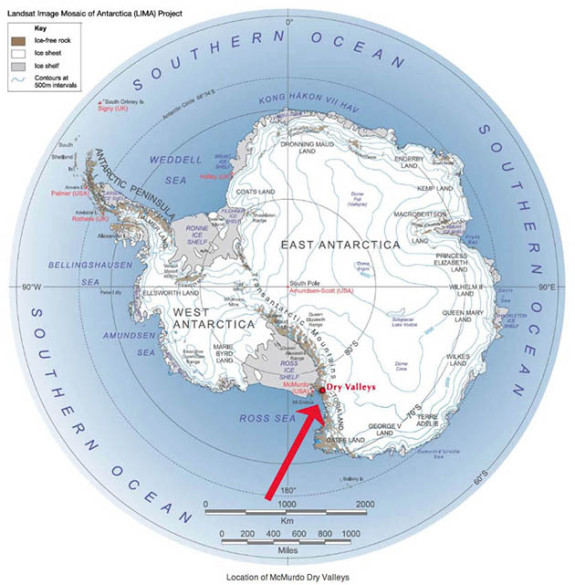
Landsat satellite mosaic of Antarctica, showing the location of the Dry Valleys, via University of Texas via Motherboard.
Landsat satellite mosaic of Antarctica, showing the location of the Dry Valleys, via University of Texas

Antarctic permafrost melting 10 times faster than in 11 thousand years. Publishing in the journal Nature on July 24, 2013, scientists at the University of Texas report on their study of one of Antarctica’s McMurdo Dry Valleys, showing that the rate of permafrost melting there is now 10 times the historic rate documented for the entire present geological epoch.

Prior to this finding, the permafrost in this region of Antarctica was assumed to be stable. These researchers say this permafrost melting in this part of Antarctica has accelerated so that it’s now “comparable to the Arctic.”

UT’s Joseph Levy and his team documented the change through LIDAR – a detection system that works on the principle of radar, but uses light from a laser – and time-lapse photography. They found a rapid retreat of ground ice in Garwood Valley, one of the McMurdo Dry Valleys, similar to the lower rates of permafrost melt observed in the coastal Arctic and Tibet. Levy said:

The big tell here is that the ice is vanishing — it’s melting faster each time we measure. This is a dramatic shift from recent history.

Describing this study for Motherboard, Mat McDermott wrote:

As opposed to the potentially catastrophic bump in greenhouse gas emissions that could result if Arctic permafrost quickly melts, scientists here are presenting their findings as more of an interesting geologic curiosity. As the ground continues to thaw, researcher believe the landscape will sink and buckle, creating retrogressive thaw slumps. 
Furthermore, unlike other ice melting in Antarctica which can contribute significantly to sea-level rise depending upon whether its already floating on the water or resting on solid ground, the ground ice melting here isn’t really a major component of the frozen water on the continent.

Read more about Levy’s study from the University of Texas

Bottom line: Two recent studies use the phrase “10 times faster” to describe ongoing climate warming. One study, from Stanford University, suggests that climate change is happening 10 times faster than it has at any time in the past 65 million years. The other study, from the University of Texas, suggests that Antarctic permafrost is now melting 10 times Faster than it has in 11,000 years, adding further evidence that Earth’s Antarctic is, in fact, warming just as Earth’s Arctic is.

Friday, August 9, 2013

RATTLE & HUM: Unexplained Phenomena - Researcher Declares That Mysterious Windsor Hum Is REAL?!

August 02, 2013 - CANADA - Colin Novak has hunch about where hum is originating, but won't reveal location until fall. 


A University of Windsor professor studying the Windsor Hum is convinced it's real. 

Colin Novak set up a state-of-the-art, $250,000 recording station in a woodlot in the western part of the Ontario city in February. It's a virtual ear, tuned to record the hum 24/7. 

Novak and a group of fellow scientists and researchers from the University of Windsor and London's University of Western Ontario received federal funding to study the mysterious noise

When the sound he's looking for rises above a certain level it's registered on the equipment and Novak gets an email. 

He said for the last month or so, his inbox has been full. 

Ottawa is funding research of the mysterious Windsor Hum.CBC News

"Some of the evenings, we may get 30 or 40 emails in a given night, mostly between midnight and about 3:30 a.m.," Novak said. 

That's enough to convince him the hum is real. 

"We're in a pretty remote area in the night time. There's some construction activity happening right now, but at night, there's not too much out here.... when we're getting levels as high as we are, there's definitely some activity," he said. 

The equipment's location hasn't been made public, but it's located in an area where the hum has been heard by Windsor residents. 

Novak said he has an idea where the sound is coming from, but he won't speculate until his research is finished. 

He and his partners will report their findings to the federal government by the end of the year. 

"And from that point forward, I think it may become more of a political, and an engineering problem," Novak said. 

People who live in the area have some theories of their own as to where the sound is originating. 

Archie Cormier is a Windsor resident who claims to hear the noise. 

Google.

"It's on the American side, and it doesn't do it all the time," he said of the noise. "So, if they can pinpoint the problem, then maybe they could find a solution." 

Last year, a federal study suggested the hum may originate from the U.S. side of the Detroit River, in the general area of Zug Island, an area of concentrated steel production and manufacturing in River Rouge, Mich. 

The mayor of River Rouge said in 2011 that his city didn't have the funds to investigate the hum. 

The map below shows the location of Zug Island, southwest of Detroit. - CBC News.

Thursday, August 8, 2013

You Won't BELIEVE What's Going On At Fukushima Right Now - State Of Emergency At Fukushima Declared, Radioactive Water Likely Breached Barrier; Huge Leak Of Tritium Feared, As Toxic Water Entering Sea For Years Tainting Ocean Life!

August 05, 2013 - JAPAN - You’ve heard bad news about Fukushima recently. But it’s much worse than you know.


You Won't BELIEVE What's Going On At Fukushima Right Now.
The Wall Street Journal notes that radiation levels outside the plant are likely higher than inside the reactor:
NRA [Nuclear Regulation Authority] officials said highly contaminated water may be leaking into the soil from a number of trenches, allowing the water to seep into the site’s groundwater and eventually into the ocean.

***

Both radioactive substances are considered harmful to health. An NRA official said Monday that the very high levels were likely to be even higher than those within the reactor units themselves.

***

It was by far the highest concentration of radioactivity detected since soon after Japan’s March 2011 earthquake and tsunami ….
How could it be more radioactive outside the nuclear reactors? The reactors have lost containment, and experts have no idea where the nuclear cores are.

And the problems which have been detected at ground-level are only the tip of the iceberg.  Japan Timespoints out:

Cesium levels in water under Fukushima No. 1 plant soar the deeper it gets, Tepco reveals

***

Tepco found 950 million becquerels of cesium and 520 million becquerels of beta ray-emitting radioactive substances, including strontium, in the water from 13 meters [~43 feet] underground.

Water from 1 meter down contained 340 million becquerels, and a sample from 7 meters down contained 350 million becquerels.

***

Cesium, a metallic element, is subject to gravity.
Yomiuri reports that highly-radioactive groundwater could start coming to the surface at the Fukushima plant:
TEPCO spokesman Noriyuki Imaizumi revealed the water level of the tainted groundwater in a test well located on the sea side of the No. 2 reactor has risen rapidly.

If the water level continues to rise, it could reach the ground surface,” Imaizumi, an acting general manager of the company’s nuclear power-related division, said at a press conference Monday.

According to the company, the water level has risen about 70 centimeters over the past 20 days.

***

To prevent contaminated groundwater from leaking into the sea, TEPCO is working to reinforce the ground foundation of seawalls. The rising water level in the test well means the measures to prevent leakage have been working.

However, the company apparently failed to give much thought to the fact that the groundwater would have nowhere else to go ….
Even Tepco admits that the groundwater problems are due to a lack of planning.  NHK points out:
[Tepco] learnt on Wednesday that its efforts to prevent radiation-tainted groundwater from seeping into the sea are failing.

***

TEPCO has been trying to solidify the embankment of the crippled power plant.

***

TEPCO says water levels in one of the contaminated wells have risen by about 1 meter since the work began in early July.

It says this is likely the result of its work to solidify the ground  [to a depth of 16 meters], using chemicals.

The company says soil up to 2 meters below the ground cannot be hardened, and water may be seeping out.
In addition, a top expert says that radioactive water could be flowing beneath the seafloor … and could well up outside of the port “containment” zone:
Atsunao Marui, head of the Groundwater Research Group at the National Institute of Advanced Industrial Science and Technology, said, “Groundwater also flows beneath the seafloor, so it’s possible that contaminated groundwater could spring up outside the port.”

Marui added that water outside the port also needs to be carefully checked.
Reuters notes that the bolts in Fukushima’s tanks will corrode in just a few years, and a plant workers reveal — “Tepco says it doesn’t know how long tanks will hold”:
Experts say Tepco is attempting the most ambitious nuclear clean-up in history, even greater than the Chernobyl disaster ….

***

Radioactive water that cools the reactors …]mixes with some 400 tonnes of fresh groundwater pouring into the plant daily.

Workers have built more than 1,000 tanks ….

With more than 85 percent of the 380,000 tonnes of storage capacity filled, Tepco has said it could run out of space.

The tanks are built from parts of disassembled old containers brought from defunct factories and put together with new parts, workers from the plant told Reuters. They say steel bolts in the tanks will corrode in a few years.

Tepco says it does not know how long the tanks will hold.
Asahi writes:
[Tepco's] appallingly shoddy handling of radioactive water that is leaking from the crippled plant into the sea.

***

At the No. 3 reactor, highly radioactive “mystery steam” has been spotted.

The fact that radioactive substances are still being released into the ground, the sea and the air is irrefutable proof that the nuclear disaster of March 2011 is not over. The responsible parties must take this situation gravely ….
The utility’s glaring ineptitude with crisis management was noted right from the start of the Fukushima disaster.

***

We have zero faith in the utility’s reliability as an operator of any nuclear power plant.In fact, allowing the company to handle nuclear energy is simply out of the question.

The entire company now needs to be focused on preventing radioactive substances from escaping into the environment.
Yomiuri argues that the government agency overseeing Fukushima has no idea what’s going on:
The Nuclear Regulation Authority, which oversees safety management at the nuclear plant, decided to set up a working team to analyze conditions concerning contamination.

But the NRA’s actions have also been badly delayed. At a meeting Monday, an expert said the NRA “still can’t grasp the risks posed by the current situation.”
As Enformable points out, top Japanese officials are finally calling for Tepco to be fired:
In case one hasn’t paid attention the constant stream of international experts who have called for TEPCO to be removed as the organization in charge of decommissioning the crippled Fukushima Daiichi reactors, Shunichi Tanaka, chairman of Japan’s Nuclear Regulation Authority has also called for Tokyo Electric to be removed. “It is simply too big for one company to handle,” said Tanaka, at a press conference Wednesday. “Placing all the burden (of controlling the site) on them won’t solve the problem.”
(Background.)
Remember, an official Japanese government investigation concluded that the Fukushima accident was a “man-made” disaster, caused by “collusion” between government and Tepco and bad reactor design.  And yet the Japanese government has allowed the culprit – Tepco – to oversee the “cleanup”, in the same way that the U.S. government allowed BP to oversee the “cleanup” of the Gulf oil spill even though BP’s criminal negligence caused the spill in the first place.
ABC Australia reports:

It’s taken about two-and-a-half years, but it seems the Japanese government is finally losing patience with the operator of the Fukushima nuclear plant. The reason: its haphazard approach to stabilising the complex. Last week it was unexplained steam rising from the shattered remains of the building housing the melted reactor number three. This week it’s TEPCO’s admission that radioactive water from the plant has probably been leaking into the Pacific for the last three months.
Indeed, Asahi notes:
The operator of the crippled Fukushima No. 1 nuclear power plant sat on its hands for more than two years despite having pledged to seal a leaking hole in a turbine building ….
NHK writes:
[Chief Cabinet Secretary Yoshihide] Suga told reporters after the Cabinet meeting on Tuesday that the government views this as a grave matter.
Tepco’s own advisors are also blasting the operator of the stricken nuclear plant.  AFP points out:
Foreign nuclear experts on Friday blasted the operator of Japan’s crippled Fukushima nuclear plant, with one saying its lack of transparency over toxic water leaks showed “you don’t know what you’re doing”… “appears that you are not keeping the people of Japan informed. These actions indicate that you don’t know what you are doing … you do not have a plan and that you are not doing all you can to protect the environment and the people.” [said Dale Klein, Former NRC Chairman and Tepco advisory committee member]
Nuclear expert – and former high-level nuclear industry executive – Arnie Gundersen says that Fukushima has“contaminated the biggest body of water on the planet”, and that the whole Pacific Ocean likely to have cesium levels 5-10 times higher than at peak of nuclear bomb tests.
How could this happen?   Doesn’t the ocean dilute radiation to the point it is rendered harmless?  No, actually:

Japan Times notes:
Fukushima … seems to lurch from one problem to the next ….

***

When the situation is so bad that Shunichi Tanaka, the NRA chairman, is stating in a press conference, with regard to water leaks, that “if you have any better ideas, we’d like to know,” it should be clear that Fukushima No. 1 still requires the upmost attention.
The chairman of the NRA also says (via the New York Times):
Considering the state of the plant, it’s difficult to find a solution today or tomorrow… That’s probably not satisfactory to many of you. But that’s the reality we face after an accident like this… We don’t truly know whether that will work….
Indeed, technology doesn’t currently even exist to stabilize and clean up Fukushima, and Tepco – with no financial incentive to actually fix things – has only been pretending to clean it up. And see this. - Zero Hedge.


State Of Emergency At Fukushima, Radioactive Water Likely Breached Barrier.
Radioactive groundwater at Japan's crippled Fukushima nuclear plant has likely risen above an underground barrier meant to contain it, presenting an "emergency" that the plant's operator is not sufficiently addressing, a regulatory watchdog official said on Monday. 

This contaminated groundwater is likely seeping into the sea, exceeding legal limits of radioactive discharge, and a workaround planned by Tokyo Electric Power Co will only forestall the growing problem temporarily, Shinji Kinjo, head of a Nuclear Regulatory Authority task force, told Reuters.

"Right now we have a state of emergency," Kinjo said, saying there is a "rather high possibility" that the radioactive wastewater has breached the barrier and is rising towards the ground's surface, Kinjo said.

A Tepco official said the utility was taking various measures to prevent contaminated water from leaking into the bay near the plant.

It was not immediately clear how much of a threat the possible increase in contaminated groundwater could cause. In the weeks following the 2011 disaster that destroyed the plant, the Japanese government allowed Tepco to dump tens of thousands of tonnes of contaminated water into the nearby Pacific Ocean in an emergency move.

The toxic water release was heavily criticised by neighbouring countries as well as local fishermen and the utility has since promised it would not dump irradiated water without the consent of local townships. -Reuters.


Huge Leak Of Tritium Feared, As Toxic Water Entering Sea For Years Tainting Ocean Life.
Tokyo Electric Power Co. said Friday that an estimated 20 trillion to 40 trillion becquerels of tritium from the Fukushima No. 1 nuclear plant may have flowed into the Pacific Ocean since May 2011.

The utility reported the estimate Friday to the Nuclear Regulation Authority after recently admitting that toxic water from the emergency cooling system set up after the nuclear crisis began on March 11, 2011, is leaking into the sea.

Nevertheless, Tepco said the size of the release is roughly in the allowed range of 22 trillion becquerels a year but acknowledged it didn’t take place in a controlled manner. Tritium has a half-life of about 12 years.

Since it doesn’t know when the leak began, the utility has assumed the beginning was in May 2011, after it attempted to stop the toxic water from entering the ocean when it was discovered in April 2011.

The constant injection of water that is needed to keep the damaged reactors cool after the core meltdowns of March 2011 are generating a new radiation crisis at the plant that officials appear unable to solve without tainting the ocean and marine life. Japan Times.

Wednesday, August 7, 2013

Exclusive: Japan nuclear body says radioactive water at Fukushima an 'emergency'

Via reuters.com, 5 August 2013 - Highly radioactive water seeping into the ocean from Japan's crippled Fukushima nuclear plant is creating an "emergency" that the operator is struggling to contain, an official from the country's nuclear watchdog said on Monday.


A view of the destroyed roof of the No.3 reactor building of Tokyo Electric Power Co. (TEPCO)'s tsunami-crippled Fukushima Daiichi nuclear power plant is seen in Fukushima prefecture February 20, 2012. REUTERS/Issei Kato
A view of the destroyed roof of the No.3 reactor building of Tokyo Electric Power Co. (TEPCO)'s tsunami-crippled Fukushima Daiichi nuclear power plant is seen in Fukushima prefecture February 20, 2012.

This contaminated groundwater has breached an underground barrier, is rising toward the surface and is exceeding legal limits of radioactive discharge, Shinji Kinjo, head of a Nuclear Regulatory Authority (NRA) task force, told Reuters.

Countermeasures planned by Tokyo Electric Power Co are only a temporary solution, he said.

Tepco's "sense of crisis is weak," Kinjo said. "This is why you can't just leave it up to Tepco alone" to grapple with the ongoing disaster.

"Right now, we have an emergency," he said.

Tepco has been widely castigated for its failure to prepare for the massive 2011 tsunami and earthquake that devastated its Fukushima plant and lambasted for its inept response to the reactor meltdowns. It has also been accused of covering up shortcomings.

It was not immediately clear how much of a threat the contaminated groundwater could pose. In the early weeks of the disaster, the Japanese government allowed Tepco to dump tens of thousands of metric tons of contaminated water into the Pacific in an emergency move.

The toxic water release was however heavily criticized by neighboring countries as well as local fishermen and the utility has since promised it would not dump irradiated water without the consent of local townships.

"Until we know the exact density and volume of the water that's flowing out, I honestly can't speculate on the impact on the sea," said Mitsuo Uematsu from the Center for International Collaboration, Atmosphere and Ocean Research Institute at the University of Tokyo.

"We also should check what the levels are like in the sea water. If it's only inside the port and it's not flowing out into the sea, it may not spread as widely as some fear."

NO OTHER OUTLET FOR WATER

Tepco said it is taking various measures to prevent contaminated water from leaking into the bay near the plant. In an e-mailed statement to Reuters, a company spokesman said Tepco deeply apologized to residents in Fukushima prefecture, the surrounding region and the larger public for causing inconveniences, worries and trouble.

The utility pumps out some 400 metric tons a day of groundwater flowing from the hills above the Fukushima Daiichi nuclear plant into the basements of the destroyed buildings, which mixes with highly irradiated water that is used to cool the reactors in a stable state below 100 degrees Celsius.

Tepco is trying to prevent groundwater from reaching the plant by building a "bypass" but recent spikes of radioactive elements in sea water has prompted the utility to reverse months of denials and finally admit that tainted water is reaching the sea.

In a bid to prevent more leaks into the bay of the Pacific Ocean, plant workers created the underground barrier by injecting chemicals to harden the ground along the shoreline of the No. 1 reactor building. But that barrier is only effective in solidifying the ground at least 1.8 meters below the surface.

By breaching the barrier, the water can seep through the shallow areas of earth into the nearby sea. More seriously, it is rising toward the surface - a break of which would accelerate the outflow.

"If you build a wall, of course the water is going to accumulate there. And there is no other way for the water to go but up or sideways and eventually lead to the ocean," said Masashi Goto, a retired Toshiba Corp nuclear engineer who worked on several Tepco plants. "So now, the question is how long do we have?"

Contaminated water could rise to the ground's surface within three weeks, the Asahi Shimbun said on Saturday. Kinjo said the three-week timeline was not based on NRA's calculations but acknowledged that if the water reaches the surface, "it would flow extremely fast."

A Tepco official said on Monday the company plans to start pumping out a further 100 metric tons of groundwater a day around the end of the week.

The regulatory task force overseeing accident measures of the Fukushima Daiichi nuclear power station, which met Friday, "concluded that new measures are needed to stop the water from flowing into the sea that way," Kinjo said.

Tepco said on Friday that a cumulative 20 trillion to 40 trillion becquerels of radioactive tritium had probably leaked into the sea since the disaster. The company said this was within legal limits.

Tritium is far less harmful than cesium and strontium, which have also been released from the plant. Tepco is scheduled to test strontium levels next.

The admission on the long-term tritium leaks, as well as renewed criticism from the regulator, show the precarious state of the $11 billion cleanup and Tepco's challenge to fix a fundamental problem: How to prevent water, tainted with radioactive elements like cesium, from flowing into the ocean.

Tuesday, August 6, 2013

MASS FISH DIE-OFF: Latest Reports Of Mysterious Fish Kills Across America - 5 More Dead Dolphins Wash Up In Virginia, Bringing The Total This Year To An Alarming 87; Thousands Of Dead Fish, Stingrays, Crabs And Shrimp Wash Ashore On Mississippi Beaches; 21 Dolphins Wash Ashore On New Jersey Beaches!

August 02, 2013 - UNITED STATES - Here are several of the latest incidents of mass fish die-offs across the United States:
Ocean View, Virginia Sees Third Dead Dolphin.
Dead dolphin in Ocean View on July 31, 2013. Photo by WAVY/Walter Hildebrand.

Another deceased dolphin was found in the Ocean View area, making it the third in a matter of days.  The bottlenose dolphin was found near Beaumont Avenue and appears to be in a decomposed state.  This is the third dead dolphin to wash up on an Ocean View beach in about a week and the fourth in the last three weeks.  Earlier this month, 10 On Your Side asked the Virginia Aquarium & Marine Science Center if there could be a connection between the dolphin deaths, and they said no. 

Now, the aquarium's biologists are a little more concerned.  "We are a little bit concerned about it," said Mark Swingle with the Virginia Aquarium. "It's definitely at a much higher level than we're used to seeing at this time of year."  Swingle said there are a number of reasons that dolphins die -- disease, predation, or just being at the mercy of fishermen's nets or boats. And even though is is prime dolphin season, the number of bottlenose dolphin deaths along the Chesapeake Bay is unusually high for this time of year.  "We have, as of this morning, about 82 dolphin strandings for the year, and typically we average in a whole year about 64 dolphin strandings. So, it's definitely elevated," Swingle said.  


WATCH: Ocean View sees third dead dolphin.


An aquarium press release said 44 of the 82 dolphin strandings this year happened in July -- the average for July is seven. The aquarium's Stranding Response Team is working with the NOAA Fisheries to investigate the causes of death, but it will take time.  "We know how to investigate dolphin strandings, we know how to look into whether or not  the animal is diseased or sick," Swingle said. "And things like that, the challenge is, it does take a little bit of time for those kind of tests to be run."  Most of the recent dolphin strandings are exclusively male, according to the aquarium release.  The aquarium is receiving help from other members of the National Marine Mammal Stranding Network, and so some of the dolphins from Hampton Roads will be transported to North Carolina for examination.  If you see a stranded animal on the beach, do not touch it. Instead, call the stranding hotline anytime of day or night: (757) 385-7575. - WAVY.

5 More Dead Dolphins Wash Up In Virginia, Bringing The Total This Year To 87.
Five more dolphins have washed up dead on beaches in Virginia Thursday.  The Virginia Aquarium and Marine Science Center confirms to NewsChannel 3 that one dolphin was found in the Ocean View section of Norfolk and four others were found in counties including Mathews and Gloucester.  The 5 additional dolphin deaths bring the total number of stranded dolphins recovered by the Virginia Aquarium’s Stranding Response Team to 87 for the year.  In July, 44 dolphins were recovered by the team, compared to 7 they typically see in that month.


WATCH: 5 more dead dolphins wash up in Virginia.


Read more about the Virginia strandings here.

Virginia isn’t the only state dealing with the increase in dolphin strandings. New Jersey is also reporting a higher than usual number of dead dolphins washing up on shore.  Maggie Mooney-Seus, a spokeswoman for NOAA’s National Marine Fisheries Service, tells NewsChannel 3 that the agency has e-mailed an alert to stranding teams along the East Coast asking them to monitor and report dolphin deaths.  The agency is hoping to collect information to see if there are any trends.  NewsChannel 3 also spoke with the Karen Clark, program coordinator for the Outer Banks Center for Wildlife Education, who reports that the number of dolphin strandings in the Outer Banks have not increased and remain typical compared to previous years.

The Virginia Aquarium Stranding Response Team stresses that if you find a dolphin on the beach, don’t touch it, but immediately call the Stranding Response Team. Their hotline is (757)385-7575 and is staffed 24-hours a day, 7 days a week. To learn more about how to report a stranding, click here. - WTKR.

Thousands Of Dead Fish, Stingrays, Crabs And Shrimp Wash Ashore On Mississippi Beaches.
This year's "dead zone" in the Gulf of Mexico is more than twice the size of last year's.  CBS News


On the pristine beaches of Mississippi, thousands of dead fish, stingrays, crabs and shrimp have washed ashore this month. They died from a lack of oxygen in the coastal waters of the Gulf of Mexico.   It's called the "dead zone," and it appears every summer. This year's dead zone, though, is larger than average and more than twice the size of last year's.  "The alarming news is that it continues to be large year after year after year," says marine biologist Nancy Rabalais has measured the dead zone since 1985.  The primary cause of the dead zone is nitrogen-based fertilizers in Midwest fields that are washed down the Mississippi River by spring rains and in to the Gulf. There they create blooms of algae that rob the water of oxygen.

Scientists believe last year's drought has made the dead zone worse, as fertilizer that was never absorbed by crops was swept into the Gulf.  In Dulac, La., David Chauvin worries about what that could do to his shrimp business.  "Shrimp are one of the most fragile creatures on the face of the earth," he says. "You take a shrimp and put them into a bucket with no oxygen whatsoever, they'll die within seconds. ... That could mimic a dead zone."  It's not just his business that's at risk. Seafood in this part of the Gulf is a $2 billion a year industry.  

Five years ago, the states in the Mississippi River basin agreed to a plan for reducing the amount of nitrogen flowing into the Gulf, but it had little effect. Now environmental groups are suing the federal government, calling for standards that are enforced.  Chauvin says that right now, it doesn't sound like the government is "doing anything."  The dead zone usually lasts until late summer or early fall, when powerful storms churn the Gulf and put the oxygen back in the water, leaving people here wondering what's worse -- a dead zone or a hurricane. - WTSP.

21 Dolphins Wash Ashore On New Jersey Beaches.
Two pods of dolphins swam by a group of lifeguards during a morning competition off the beach here Wednesday.  It was the serene summer scene any lifeguard appreciates, but New Jersey guards have had many grimmer encounters with dolphins in recent weeks.  Since a dead dolphin was found in the Elberon section of Long Branch on July 9, 21 dead dolphins have washed onto beaches from Monmouth County to Cape May County, said Bob Schoelkopf, founding director of the Marine Mammal Stranding Center, which has responded to each.

What’s causing the deaths isn’t yet clear. The number of dolphins brought in for testing — an average of two per day — has delayed the center from getting closer to an answer, Schoelkopf said.  “This is unusual,” he said. “It’s a high number.”  Officials at the National Oceanic and Atmospheric Administration’s National Marine Fisheries Service said last week that a typical year could see more than 1,000 strandings of dolphins and other marine animals such as seals and whales from Maine to Virginia.  

This time of year often leads to dolphin strandings because they are migrating and between more boats in the water and a higher population, human interaction or just a sudden sickness could bring a dolphin to shore, said Maggie Mooney-Seus, NOAA’s Northeast Fisheries Science Center’s communications specialist.  Fisheries have started collecting information, which includes asking its other regional stranding network members to report any strandings they have so NOAA can track any trends, Mooney-Seus said.

Schoelkopf said all but one of the beached animals have been bottlenose dolphins. A common dolphin was brought in Tuesday after washing onto the beach in Harvey Cedars. They range from 125 to 500 pounds, he said.  The stranding center picks up the animals, briefly studies them at their headquarters in Brigantine, and then takes them to the New Bolton Center in Chester County, Pa. There, they undergo a necropsy — an autopsy for animals.

“We keep taking them (animals) every day. The lab is pushing as hard as they can,” he said.  While the locations of the dead dolphins has varied, Schoelkopf said his staff has found nine of the dolphins along the 18-mile stretch of Long Beach Island. Long Beach Township has had to report three dead dolphins, Beach Patrol Supervisor Don Myers said.  The three dolphins that washed on his beaches July 19, 24 and 30 came later in the day when few people were on the beach, Myers said. His staff follows protocol by keeping people away and notifying the Marine Mammal Stranding Center, he said.  His staff examined one of the dolphins, which had various cuts, scrapes and punctures. 

But he said he isn’t certain what has been impacting the dolphins.  “I tell my staff they’re mammals like we are. They have respiratory infections or die of natural causes like anything,” Myers said.  The dolphins haven’t forced beach closures and the health department cleared the beach of health issues, Myers said. His beach hasn’t had problems with sharks, either, he said.  Schoelkopf said some of the dolphins that they found had been badly decomposed because of sharks eating the carcasses.  He is urging anyone who sees a dolphin to keep themselves, their pets and children away from it and to report it immediately to the center or local authorities, such as police or lifeguards. - Daily Record.