Showing posts with label Japan 311 earthquake. Show all posts

Saturday, July 11, 2015

FUK-U-SHIMA: The United Nations Says TEPCO May Need To Dump Fukushima Water Into The Sea - As Officials Record 6,000 PERCENT Cancer Rate Increase In Children's Thyroid; And Mysterious Deadly Transparent Fungus Is Found In Fish In The Pacific Northwest!

Posted by 


Tokyo Electric Power Co. (Tepco) employees, wearing protective suits and masks, are seen near tanks of radiation-contaminated water at the company's

Fukushima Dai-Ichi nuclear power plant. Photographer: Issei Kato/Pool via BloombeMay 21, 2015 - JAPAN 
Tokyo Electric Power Co. should consider discharging water contaminated by the Fukushima Daiichi reactor meltdowns into the Pacific Ocean, 
the International Atomic Energy Agency said.
More than four years after the nuclear power-plant disaster in Japan, the United Nations agency renewed pressure for an alternative to holding the tainted water in tanks and offered to help monitor for offshore radiation.

“The IAEA team believes it is necessary to find a sustainable solution to the problem of managing contaminated water,” the Vienna-based agency said in a report. “This would require considering all options, including the possible resumption of controlled discharges into the sea.’

Tepco officials are still using water to cool molten nuclear fuel from the reactors and while on-site tanks were installed to hold 800,000 cubic meters of effluent, engineers have battled leaks and groundwater contamination. The assessment, published Thursday, 
was based on visits by an IAEA team in February and April.

The IAEA also said it would send scientists to collect water and sediment samples off the Fukushima coastline to improve data reliability.

‘‘TEPCO is advised to perform an assessment of the potential radiological impact to the population and the environment arising from the release of water containing tritium and any other residual radionuclides to the sea in order to evaluate the radiological significance,’’ the agency said.
 ‘‘The IAEA team recognizes the need to also consider socioeconomic conditions .’’

Fishermen ProtestPrevious releases of Fukushima contamination into the Pacific have drawn protests by Japanese fishermen and environmental groups. Fish caught off the coast of Fukushima have been subject to testing for radiation before being sold.

Contamination from Fukushima has been measured off the western coasts of the U.S. and Canada, signaling the need for more monitoring, according to the Woods Hole Oceanographic Institution, the largest private non-profit research group looking at the world’s oceans.

Though contamination levels off the North American coast are ‘‘extremely low,’’ oceans need to be monitored ‘‘after what is certainly the largest accidental release of radioactive contaminants to the oceans in history,’’ Ken Buesseler, a marine chemist at Woods Hole, said last month. - Bloomberg.


Mysterious deadly transparent fungus being found on fish in Pacific Northwest — Gov’t: There was some concern Fukushima radiation could be involved — Biologists investigating how this landbased mold is now appearing in ocean — Many reports of unusual rotting sores, growths, bumps, cancer [PHOTOS]

The Nome office of the Alaska Department of Fish and Game received several reports of tomcod with transparent lesions this year… 
ADF&G fishery biologists speculate that the lesions are a fungus… Specifically, transparent mold, commonly found in houses… 
What the pathology lab finds interesting is that this fungus is landbased and yet it is appearing on fish 
Fish pathologists would like to receive as many samples as possible so that they may adequately research what exactly is infecting these fish, 
as well as its affect on humans. Until further notice, ADF&G recommends that fish with lesions should not be eaten due to possible human health concerns
 (CAPTION: DON’T EAT THIS— ADF&G biologists are investigating transparent lesions found on tomcods in the region. 
Until it is known what the lesions exactly are, the department recommends not to consume fish showing these symptoms) - 
[PDF], Nov 27, 2014 (emphasis added) - Nome Nugget.


Just a quick word on this fungus that people are seeing more and more ofIt’s probably what’s called saprolegnia. It’s a water mold… It’s in the water at all times… healthy fish will swim around and never get it,
 but if the fish is stressed nutritionally or its immune system has been compromised… that gives a pathway for the mold to attack… It will eventually kill the fish… We saw something similar last summer. 
We had a very big die-off on the Kobuk River…
 we had thousands of dead chum salmon… and they had had presence of the same mold on them.  - [PDF], Mar 17, 2015 - Brendan Scanlon, fishery biologist for North Slope Dept. of Fish & Game.


Dr. Jayde Ferguson, Alaska Dept of Fish & Game: The first confirmed report was from fish caught on Oct. 12, 2013… There was some concern that radiation from the Japanese disaster could be involved,
so the North Slope biologist measured ionizing radiation in fish with a geiger-mueller counter and found that there was no elevated levels there… There was no food in the GI track and there was no fat or very 
little fat internally
 The external lesions… corresponded to saprolegnia… it can act as a pathogen particularly in stressed fish because their immune system is depressed… I wanted to touch on a totally unrelated fungal case that is of interest
 to our lab because there’s not a lot known about it and it’s distinctly different from the saprolegnia in that it’s very transparent and large… there’s not a lot out in the literature on this transparent fungus… There’s just not a lot known about transmission or anything else, so we’re wanting to get a better idea of what’s going on…
Dr. Todd Sformo, Wildlife Biologist: I think the main concern was that if this mold is really present in the environment… it’s been reported a lot… why is the mold coming up being on fish at this point? So we have very few records in the north slope and Jayde mentioned the one… in the 1980s, so that was just one fish with that mold that we had recorded up until this point… why is it occurring now if it’s so prevalent in the environment?… We measured a number of the fish that were caught that had the mold and that did not have the mold and the size of the fish didn’t seem to matter at all…
Ferguson: If we’re seeing it in juveniles that really does support some environmental issue… How many fish are affected?… It might not have an impact at the population level, but if there’s a large amount of fish that are affected, then that’s a different thing.
[PDF], Feb 20, 2014 - North Slope Federal Subsistence Regional Advisory Council.


02-02-15 – Whitefish that had a bulged out eye ball [and] some type of growth around the cheekbone. Would like to know the cause of these observed abnormalities
12-10-14 – Whitefish… has a brownish moldy growth all over it’s body. We would like to know more about what is going on with our fish and why this is happening
10-24-14 – Trout appeared to have sores… rotting or decaying… [we] have never seen these sores before… We are still seeing a lot of fish with these kinds of conditions
06-12-14 – A codfish that was caught with a deep cut or sore on it was pulled in… We are not really sure what happened to this poor cod, but we think it is unusual
05-26-14 – Whitefish that had a growth… on its dorsal fin. Other fish were also caught with a similar condition… ADF&G: “This whitefish has… probably a neoplasm (cancer)”
02-17-14 – Fish… found with lesions on them… Other people also said they saw these bumps… elders who said they have seen fish with skin bumps like this once before…  people are still worried because they are not sure what it is this time…. these bumps… were like puss. There are quite a few people who are worried…
Alaska Native Tribal Health Consortium.
- See more at: http://thecelestialconvergence.blogspot.hk/#sthash.tqJwWaSI.dpuf

Saturday, June 27, 2015

What Is a Tsunami?

By Matt Williams via Universe Today, 24 June 2015
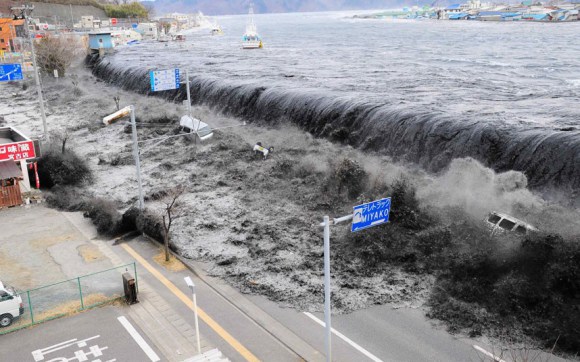
The wave from a tsunami crashes over a street in Miyako City, Japan on March 11th, 2011. Credit: REUTERS/Mainichi Shimbun

For people living in oceanfront communities, the prospect of a tsunami is a frightening one. Much like earthquakes, volcanoes, hurricanes and tornadoes, tsunamis are one of the most destructive natural forces on the planet. And much like these other phenomena, they require the right conditions to happen and are more common in some areas of the world than others.

Knowing how and when a tsunami will strike has therefore a subject of great interest for scientists over the ages. But for anyone who has lived in certain parts of the world where “tsunami zones” are common – namely Japan and the South Pacific – it is a matter of survival.

Definition:
Numerous terms are used in the English language to describe large waves created by the displacement of water, with varying degrees of accuracy. The term tsunami, for example, is literally translated from Japanese to mean “harbor wave”. There are only a few other languages that have an equivalent native word, though similar meanings can be found in Indonesia, Sri Lanka, and the Indian Subcontinent.

The term tidal wave has also been used, which is derived from the most common appearance of a tsunami – an extraordinarily high tidal bore. However, in recent years, the term “tidal wave” has fallen out of favor with the scientific community because tsunami actually have nothing to do with tides, which are produced by the gravitational pull of the moon and sun rather than the displacement of water.

Tsunamis initiate when an earthquake causes the seabed to rupture, which leads to a rapid decrease in sea surface height directly above it. Credit: howitworksdaily.com

The term seismic sea wave also is used to refer to the phenomenon, due to the fact that the waves most often are generated by seismic activity such as earthquakes. However, like “tsunami,” “seismic sea wave” is not a completely accurate term, as forces other than earthquakes – including underwater landslides, volcanic eruptions, underwater explosions, land or ice slumping into the ocean, meteorite impacts, or even sudden changes in weather – can generate such waves by displacing water.

Causes:
The principal cause of a tsunami is the displacement of a substantial volume of water or perturbation of the sea. This is usually the result of earthquakes, landslides, volcanic eruptions, glacier calvings, or more rarely by meteorites and nuclear tests. The waves formed in this way are then sustained by gravity.

Tectonic earthquakes trigger tsunamis when the sea floor abruptly deforms and vertically displaces the water above. More specifically, a tsunami can be generated when thrust faults associated with convergent or destructive plate boundaries move abruptly and displace water.

Tsunamis have a small amplitude (wave height) offshore, and a very long wavelength (often hundreds of kilometers long), and only grow in height when they reach shallower water. Once there, the wavelength shortens as the wave encounters resistance, thus increasing the amplitude increases and causing the wave to rears up in a massive tidal bore.


In the 1950s, it was discovered that tsunamis larger than what had previously been believed possible could be caused by giant submarine landslides. These rapidly displace large water volumes, as energy transfers to the water at a rate faster than the water can absorb. Their existence was confirmed in 1958, when a giant landslide in Lituya Bay, Alaska, caused the highest wave ever recorded (524 meters/1700 feet).

A village near the coast of Sumatra that was devastated by the Tsunami that struck South-East Asia in 2004. Credit: US Navy/Public Domain

In general, landslides generate displacements mainly in the shallower parts of the coastline, such as in closed bays and lakes. But an open oceanic landslide large enough to cause a tsunami across an ocean has not yet happened since the advent of modern seismology, and only rarely in human history.

Meteorological phenomena, such tropical cyclones, can generate a storm surge that will cause sea levels to rise, often in coastal regions. These are what is known as meteotsunamis, which are tsunamis triggered by sudden changes in weather. When such tsunamis reach shore, they rear up in shallows and surge laterally, just like earthquake-generated tsunamis.

Tsunamis can also be triggered by external factors, such as meteors or human intervention. For instance, when a meteor of significant strikes a region of the ocean, the resulting impact is enough to displace high volumes of water, thus triggering a tsunami. There has also been much speculation since World War II of how a nuclear detonations have trigger a tsunami, but all attempts at research (especially in the Pacific) have yielded poor results.

Characteristics and Effects:
Tsunamis can travel at well over 800 kilometers per hour (500 mph), but as they approach the coast, wave shoaling compresses the wave and its speed decreases to below 80 kilometers per hour (50 mph). A tsunami in the deep ocean has a much larger wavelength of up to 200 kilometers (120 mi), but diminishes to less than 20 kilometers (12 mi) when it reaches shallow water.

When the tsunami’s wave peak reaches the shore, the resulting temporary rise in sea level is termed run up. Run up is measured in metres above a reference sea level. A large tsunami may feature multiple waves arriving over a period of hours, with significant time between the wave crests.

Tsunamis cause damage by two mechanisms. First, there is the smashing force of a wall of water traveling at high speed, while the second is the destructive power of a large volume of water draining off the land and carrying a large amount of debris with it.

It is often difficult for people to recognize a tsunami in the open ocean because the waves are much smaller further out at sea than they are close to shore. As with earthquakes, several attempts have been made to set up scales of tsunami intensity or magnitude to allow comparison between different events.

Ships try to extinguish a blaze at oil refinery tanks in Ichihara, Chiba Prefecture, after the tsunami that struck in March, 2011. Credit: EPA

The first scales used routinely to measure the intensity of tsunami were the Sieberg-Ambraseys scale, used in the Mediterranean Sea and the Imamura-Iida intensity scale, used in the Pacific Ocean. This latter scale was modified by Soloviev to become the Soloviev-Imamura tsunami intensity scale, which is used in the global tsunami catalogs compiled by the NGDC/NOAA and the Novosibirsk Tsunami Laboratory as the main parameter for the size of the tsunami.

In 2013, following the intensively studied tsunamis in 2004 and 2011, a new 12 point scale was proposed, known as the Integrated Tsunami Intensity Scale (ITIS-2012). This scale was intended to match as closely as possible to the modified ESI2007 and EMS earthquake intensity scales.

Tsunamis throughout History:
Japan and the Pacific Ocean may have the longest recorded history of tsunamis, but they are an often underestimated hazard in the Mediterranean Sea region and Europe in general. In his History of the Peloponnesian War (426 BCE), Greek historian Thucydides offered what could be considered the first recorded speculation about the causes of tsunamis – where he argued that earthquakes at sea were the reason for them.

An aerial view of tsunami damage in Tohoku. Credit: US Navy

After the tsunami of 365 CE devastated Alexandria, Roman historian Ammianus Marcellinus described the typical sequence of a tsunami. His descriptions included an earthquake and the sudden retreat of the sea, followed by a gigantic wave.

More modern examples include the 1755 Lisbon earthquake and tsunami (which was caused by activity in the Azores–Gibraltar Transform Fault); the 1783 Calabrian earthquakes, which caused several ten thousand deaths; and the 1908 Messina earthquake and tsunami – which caused 123,000 deaths in Sicily and Calabria and is considered one of the most deadly natural disasters in modern European history.

But by far, the 2004 Indian Ocean earthquake and tsunami was the most devastating of its kind in modern times, killing around 230,000 people and laying waste to communities throughout Indonesia, Thailand, and Southern Asia.

In 2010, an earthquake triggered a tsunami which devastated several coastal towns in south-central Chilem, damaged the port at Talcahuano and caused 4334 confirmed fatalities. The earthquake also generated a blackout that affected 93 percent of the Chilean population.

In 2011, an earthquake off the Pacific coast of Tohoku led to a tsunami that struck Japan and led to 5,891 deaths, 6,152 injuries, and 2,584 people to be declared missing across twenty prefectures. The tsunami also caused meltdowns at three reactors in the Fukushima Daiichi Nuclear Power Plant complex.

Tsunamis are a force of nature, without a doubt. And knowing when, where, and how severely they will strike is intrinsic to ensuring that we can limit the damage they do cause.

Universe Today has articles on about tsunamis and causes of tsunamis.

For more information, try tsunami and causes of tsunamis.

Astronomy Cast has an episode on Earth.

Source:
Wikipedia

Posted with permission from UT

Wednesday, March 5, 2014

Dismantling Fukushima: The World's Toughest Demolition Project; Taking Apart The Shattered Power Station And Its Three Melted Nuclear Cores Will Require Advanced Robotics!

March 05, 2014 - JAPAN - A radiation-proof superhero could make sense of Japan’s Fukushima Daiichi nuclear power plant in an afternoon. Our champion would pick through the rubble to reactor 1, slosh through the pooled water inside the building, lift the massive steel dome of the protective containment vessel, and peek into the pressure vessel that holds the nuclear fuel. A dive to the bottom would reveal the debris of the meltdown: a hardened blob of metals with fat strands of radioactive goop dripping through holes in the pressure vessel to the floor of the containment vessel below. Then, with a clear understanding of the situation, the superhero could figure out how to clean up this mess.

Photo: Kyodo News/AP Photo

Unfortunately, mere mortals can’t get anywhere near that pressure vessel, and Japan’s top nuclear experts thus have only the vaguest idea of where the melted fuel ended up in reactor 1. The operation floor at the top level of the building is too radioactive for human occupancy: The dose rate is 54 millisieverts per hour in some areas, a year’s allowable dose for a cleanup worker. Yet, somehow, workers must take apart not just the radioactive wreck of reactor 1 but also the five other reactors at the ruined plant. 

This decommissioning project is one of the biggest engineering challenges of our time: It will likely take 40 years to complete and cost US $15 billion. The operation will involve squadrons of advanced robots, the likes of which we have never seen. 

Nothing has been the same in Japan since 11 March 2011, when one of history’s worst tsunamisflooded Fukushima Daiichi, crippled its emergency power systems, and triggered a series of explosions and meltdowns that damaged four reactors. A plume of radioactive material drifted over northeast Japan and settled on towns, forests, and fields, while plant workers scrambled to pour water over the nuclear cores to prevent further radioactive releases. Nine months later, the Tokyo Electric Power Co. (TEPCO), the utility company that operates the plant, declared the situation stable. 

Stability is a relative concept: Although conditions at Fukushima Daiichi aren’t getting worse, the plant is an ongoing disaster scene. The damaged reactor cores continue to glow with infernal heat, so plant employees must keep spraying them with water to cool them and prevent another meltdown. But the pressure vessels and containment vessels are riddled with holes, and those leaks allow radioactive water to stream into basements. TEPCO is struggling to capture that water and to contain it by erecting endless storage tanks. The reactors are kept in check only by ceaseless vigilance. 

TEPCO’s job isn’t just to deal with the immediate threat. To placate the furious Japanese public, the company must clean up the site and try to remove every trace of the facility from the landscape. The ruin is a constant reminder of technological and managerial failure on the grand scale, and it requires a proportionally grand gesture of repentance. TEPCO officials have admitted frankly that they don’t yet know how to accomplish the tasks on their 40-year road map, a detailed plan for decommissioning the plant’s six reactors. But they know one thing: Much of the work will be done by an army of advanced robots, which Japan’s biggest technology companies are now rushing to invent and build.

The Site: During the 2011 accident, reactors 1, 2, and 3 ­suffered partial meltdowns. Explosions shattered reactor
buildings 1, 3, and 4. Reactors 5 and 6 are undamaged.  Illustration: James Provost

Here’s some more bad news: Chernobyl and Three Mile Island, the only other commercial-scale nuclear accidents, can’t teach Japan much about how to clean up Fukushima Daiichi. The Chernobyl reactor wasn’t dismantled; it was entombed in concrete. The Three Mile Island reactor was defueled, but Lake Barrett, who served as site director during that decommissioning process, says the magnitude of the challenge was different. At Three Mile Island the buildings were intact, and the one melted nuclear core remained inside its pressure vessel. “At Fukushima you have wrecked infrastructure, three melted cores, and you have some core on the floor, ex-vessel,” Barrett says. Nothing like Fukushima, he declares, has ever happened before.

Barrett, who is now a consultant for the Fukushima cleanup, says TEPCO is taking the only approach that makes sense: “You work from the outside in,” he says, dealing with all the peripheral problems in the buildings before tackling the heart of the matter, the melted nuclear cores. During the first three years of the cleanup, TEPCO has been surveying the site to create maps of radiation levels. The next step is removing radioactive debris and scrubbing radioactive materials off walls and floors. Spent fuel must be removed from the pools in the reactor buildings; leaks must be plugged. Only then will workers be able to flood the containment structures so that the melted globs of nuclear fuel can safely be broken up, transferred to casks, and carted away.

Many of the technologies necessary for the decommissioning already exist in some form, but they must be adapted to fit the unique circumstances of Fukushima Daiichi. “It’s like in the 1960s, when we wanted to put a man on the moon,” says Barrett. “We had rocketry, we had physics, but we had never put all the technologies together.” Just as with the moon shot, there is no guarantee that this epic project can be accomplished. But faced with the wrath of the Japanese people, TEPCO has no choice but to try.


To begin the first step—inspection—TEPCO sent in robots to map the invisible hot spots throughout the smashed reactor buildings. The first to arrive were the U.S.-made PackBot and Warrior, hastily shipped over from iRobot Corp. of Bedford, Mass. But Japan is justly proud of its own robotics industry, so the question arose, Why didn’t TEPCO have robots ready to respond in a nuclear emergency?Yoshihiko Nakamura, a University of Tokyo robotics professor, has the dispiriting answer. The government did fund a program on robotics for nuclear facilities in 2000, following a deadly accidentat a uranium reprocessing facility. But that project was shut down after a year. “[The government] said this technology is immature, and it is not applicable for the nuclear systems, and the nuclear systems are already 100 percent safe,” Nakamura explains. “They didn’t want to admit that the technology should be prepared in case of accident.”

Still, some roboticists in Japan carried on their own research despite the government’s indifference. In the lab of Tomoaki Yoshida, a roboticist at the Chiba Institute of Technology, near Tokyo, robots have learned to crawl over rubble and to climb up and down steps. These small tanks roll on a flexible series of treads, which can be lifted or lowered individually to allow the bot to manage stairs.

After the Fukushima accident, Yoshida’s academic research became very relevant. With seed money from the government, he constructed two narrow metal staircases proportioned like the 5-floor staircases inside the Fukushima Daiichi reactor buildings. This allowed Yoshida to determine whether his bots could navigate those cramped stairs and tight turns. His acrobatic Quince robots proved themselves able, and after hundreds of tests they received TEPCO’s clearance for field operations. In the summer of 2011, the Quince bots became the first Japanese robots to survey the reactor buildings.

The Quinces were equipped with cameras and dosimeters to identify radioactive hot spots. But the robots struggled with a communication issue: The nuclear plant’s massive steel and concrete structures interfere with wireless communication, so the Quinces had to unspool cables behind them to receive commands and transmit data to their operators. The drawback of that approach soon became apparent. One Quince’s cable got tangled and damaged on the third floor of reactor 2, and the lonely bot is still sitting there to this day, waiting for commands that can’t reach it.

Armed for Duty: Mitsubishi Heavy Industries contributed this two-armed bot, the MHI-MEISTeR. Its arms can
be fitted with a variety of tools, including one drill that can take a core sample from concrete walls and floors. Each
arm has seven degrees of freedom, making the bot a versatile and flexible worker.  Photo: Kyodo/AP Photo

Back at Yoshida’s lab, where modest bunk beds bespeak the dedication of his students, the team is currently working on a new and improved survey bot named Sakura. To guard against future tangles, Sakura not only unspools cable behind, it also automatically takes up the slack when it changes direction. It’s waterproof enough to roll through puddles, and it can carry a heavy camera capable of detecting gamma radiation. The bot can tolerate that radiation: Yoshida’s team tested its electronics (the CPU, microcontrollers, and sensors) and found that they’re radiation-tolerant enough to perform about 100 missions before any component is likely to fail. However, the robot itself becomes too radioactive for workers to handle. Sakura must therefore take care of itself: It recharges its batteries by rolling up to a socket and plugging itself in.

The second step in the Fukushima decommissioning is decontamination, because only when that is complete will workers be able to get inside to tackle more complex tasks. The explosions that shattered several of the reactor structures sprayed radioactive materials throughout the buildings, and the best protective suits for workers in hot zones are of little use against the resulting gamma radiation—a worker would have to be covered from head to toe in lead as thick as the width of a hand.

After the accident, the Japanese government called for robots that could work on decontamination, and several of Japan’s leading companies rose to the challenge. Toshiba and Hitachi have designed robots that use jets of high-pressure water and dry ice to abrade the surfaces of walls and floors; the robots will scour away radioactive materials along with top layers of paint or concrete and vacuum up the resulting sludge. But the robots’ range is defined by their own communication cables, and they can carry only limited amounts of their cleaning agents. Another bot, the Raccoon, has already begun nosing across the floor in reactor building 2, trailing long hoses behind it to supply water and suction.

To clear a path for the robotic janitors, another class of robots has been invented to pick up debris and cut through obstacles. The ASTACO-SoRa, from Hitachi, has two arms that can reach 2.5 meters and lift 150 kilograms each. The tools on the ends of the arms—grippers, cutting blades, and a drill—can be exchanged to suit the task. However, Hitachi’s versatile bot is limited to work on the first floor, as it can’t climb stairs.

 
Out Of The Pool: Spent fuel pools inside the damaged reactor buildings contain hundreds of nuclear fuel
assemblies. TEPCO is emptying reactor 4’s pool [top] first. In the extraction process, a cask is lowered into
the pool and filled with radioactive fuel assemblies. Then the cask is transported to a safer location,
lowered into another pool [middle], and unloaded. The job is made more complicated because
some of the assemblies are covered with debris [bottom] from the accident's explosions.
Photos: TEPCO


Removing spent fuel rods is the third step. Each reactor building holds hundreds of spent fuel assemblies in a pool on its top floor. These unshielded pools, perfectly safe when filled with water, became a focus of public fear during the Fukushima Daiichi accident. After reactor building 4 exploded on 15 March, many experts worried that the blast had damaged the structural integrity of that building’s pool and allowed the water to drain out. The pool was soon determined to be full of water, but not before the chairman of the U.S. Nuclear Regulatory Commission had caused an international panic by declaring it dry and dangerous. The reactor 4 pool became one of TEPCO’s urgent decommissioning priorities, not only because it’s a real vulnerability but also because it’s a potent reminder of the accident’s terrifying first days.

The process of emptying that pool began in November 2013. TEPCO workers use a newly installed cranelike machine to lower a cask into the pool, then long mechanical arms pack the submerged container with fuel assemblies. The transport cask, fortified with shielding to block the nuclear fuel’s radiation, is lowered to a truck and brought to a common pool in a more intact building. The building 4 pool contains 1533 fuel assemblies, and moving them all to safety is expected to take a year. The same procedure must be performed at the highly radioactive reactors 1, 2, and 3 and the undamaged (and less challenging) reactors 5 and 6.

Containing the radioactive water that flows freely through the site is the fourth step. Every day, about 400 metric tons of groundwater streams into the basements of Fukushima Daiichi’s broken buildings, where it mixes with radioactive cooling water from the leaky reactor vessels. TEPCO treats that waterto remove most of its radioactive elements, but it can’t be rendered entirely pure—and as a result local fishermen have protested plans to release it into the sea. To store the accumulating water, TEPCO has installed more than 1000 massive tanks, which themselves must be monitored vigilantly for leaks.

TEPCO hopes to stop the flow of groundwater with a series of pumps and underground walls, including an “ice wall” made of frozen soil. Still, at some point the Japanese public must grapple with a difficult question: Can the stored water ever be released into the sea? Barrett, the former site director of Three Mile Island, has argued publicly that the processed water is safe, as contamination is limited to trace amounts of tritium, a radioactive isotope of hydrogen. Tritium is less dangerous than other radioactive materials because it passes quickly through the body; after it’s diluted in the Pacific, Barrett says, it would pose a negligible threat. “But releasing that water is an emotional issue, and it would be a public relations disaster,” he says. The alternative is to follow the Three Mile Island example and gradually dispose of the water through evaporation, a process that would take many years.

TEPCO must also plug the holes in the reactor vessels that allow radioactive cooling water to flow out. Many of the leaks are thought to be in the suppression chambers, doughnut-shaped structures that ring the containment vessel and typically hold water, which is used to regulate temperature and pressure inside the pressure vessel during normal operations. Shunichi Suzuki, TEPCO’s general manager of R&D for the Fukushima Daiichi decommissioning, explains that one of his priorities is developing technologies to find the leak points in the suppression chambers.

“There are some ideas for a submersible robot,” Suzuki says, “but it will be very difficult for them to find the location of the leaks.” He notes that both the suppression chambers and the rooms that surround them are now filled with water, so there’s no easy way to spot the ruptures; it’s not like finding the hole in a leaky pipe that’s spraying water into the air. Among the robot designs submitted by Hitachi, Mitsubishi, and Toshiba is one bot that would crawl through the turbid water and use an ultrasonic sensor to find the breaches in the suppression chambers’ walls.

If robots prove impractical, TEPCO may take a more heavy-handed approach and start pouring concrete into the suppression chamber or the pipes that lead to it. “If it’s possible to make a seal between the containment vessel and the suppression chamber, then the leaks don’t matter,” Suzuki says. One way or another, TEPCO hopes to have all the leaks stopped up within three years. Sealing the leaks is a necessary precondition for the final and most daunting task.

Water, Water Everywhere: Groundwater flowing through the site mixes with radioactive cooling water leaking
from reactor buildings and must therefore be stored and treated. To contain the accumulating water, TEPCO
is filling fields with storage tanks [bottom]. These tanks must be monitored for leaks [top]. In August 2013,
TEPCO admitted that 300 metric tons of contaminated water had leaked from one tank. 
Photos, top: TEPCO; bottom: The Yomiuri Shimbun/AP Photo


Removing the three damaged nuclear cores is the last big step in the decommissioning. As long as that melted fuel glows inside reactors 1, 2, and 3, Fukushima Daiichi will remain Japan’s ongoing nightmare. Only once the fuel is safely packed up and carted away can the memory begin to fade. But it will be no easy task: TEPCO estimates that removing the three melted cores will take 20 years or more.

First, workers will flood the containment vessels to the top so that the water will shield the radioactive fuel. Then submersible robots will map the slumped fuel assemblies within the pressure vessels; these bots may be created by adapting those used by the petroleum industry to inspect deep-sea oil wells. Next, enormously long drills will go into action. They must be capable of reaching 25 meters down to the bottoms of the pressure vessels and breaking up the metal pooled there. Other machines will lift the debris into radiation-shielded transport casks to be taken away.

Making the task more complicated is the design of the reactors. They have control rods that project through the bottom of the pressure vessels, and the entry point for each of those control rods is a weak spot. Experts believe that most of the fuel in reactor 1, and some in reactors 2 and 3, leaked down through those shafts to pool on the floor of the containment vessel below. To reach that fuel, some 35 meters down, TEPCO workers will have to drill through the steel of the pressure vessel and work around a forest of wires and pipes.

Before TEPCO can even develop the proper fuel-handling tools, Suzuki says, the company must get a better understanding of the properties of the corium—the technical term for the mess of metals left behind after a meltdown. The company can’t just copy the drills that broke up the melted core of the Three Mile Island reactor, says Suzuki. “At Three Mile Island, [the core] remained in the pressure vessel,” he says. “In our case, it goes through the pressure vessel, so it melted stainless steel. So our fuel debris must be harder.” The melted fuel may also have a lavalike consistency, with a hard crust on top but softer materials inside. TEPCO is now working with computer models and is planning to make an actual batch of corium in a laboratory to study its properties.

When the core material is broken up and contained, it will be whisked away to some to-be-determined storage facility. Over the decades its radioactivity will gradually fade, along with the Japanese public’s memory of the accident. It’s a shame that those twisted blobs of corium are too dangerous to be displayed in a museum, where a placard could explain that we human beings are so clever, we’re capable of building machines we can’t control.

Depending on whom you ask, nuclear power stations like Fukushima Daiichi are exemplars of either humanity’s ingenuity or hubris. But, the museum placard might add, these metallic blobs, plucked from the heart of an industrial horror, prove something else—that we humans also have the grit and perseverance to clean up our mistakes. - IEEE Spectrum.

Thursday, January 16, 2014

Fukushima: Your Days of Eating Pacific Ocean Fish Are Over


When it comes to environmental disasters, the nuclear fallout at Fukushima has to be amongst the worst that has happened in the past few decades. Andrew Kishner, founder of http://www.nuclearcrimes.org/ has put together a great resource of information that tracks what has been developing over time in Fukushima as it relates to the nuclear incident. You can check out his research further using the links below.
The following is written by Gary Stamper in regards to what has been happening with Fukushima.
“The heart-breaking news from Fukushima continues to get worse -a lot worse. It is, quite simply, an out-of-control flow of death and destruction.
TEPCO is finally admitting that radiation has been leaking to the Pacific Ocean all along and it’s not showing signs of stopping just yet.
It now appears that anywhere from 300 to possibly over 450 tons of contaminated water that contains radioactive iodine, cesium, and strontium-89 and 90, is flooding into the Pacific Ocean from the Fukushima Daichi site every day.
To give you an idea of how bad that actually is, Japanese experts estimate Fukushima’s fallout at 20-30 times as high as as the Hiroshima and Nagasaki nuclear bombings in 1945.
There’s a lot you’re not being told. Oh, the information is out there, but you have to dig pretty deep to find it, and you won’t find it on the corporate-owned evening news.”
Some Facts From Andrews research.
LATEST: TEPCO says they believe 10 trillion becquerels of strontium-90 (and also 20 trillion becquerels of cesium-137) have leaked into the ocean from the crippled reactor complex since 5/11. (source). This is a ridiculously low estimate. Also, radioactive tritium levels in the sea (seaport) at Daiichi are creeping up and up and up (we knew that was gonna happen).
RECENT: In the latest mess at Fukushima, one or more of the hundreds of storage tanks at the nuclear complex holding EXTREMELY radioactive liquid waste are leaking. The radioactive liquid waste is flowing into the soil and standing puddles are ‘hot,’ measuring, at surface, about 10 Rem/Hr. Even taken out of context of the ongoing ‘level 7′ Fukushima nuclear disaster, these disastrous spills are considered BAD. As it turns out, the leak crisis has received a distinct crisis categorization, classed ‘a level 3′ on an eight point international scale (INES).
RECENT: Onsite contaminated water at Fukushima contains 3x the cesium released by Chernobyl (and Mighty Oak) – SOURCE
Be sure to check out his other important findings in the links below.
- See more at: http://www.collective-evolution.com/2013/08/29/fukushima-your-days-of-eating-pacific-ocean-fish-are-over/#sthash.3J4j7BLd.dpuf

Wednesday, January 15, 2014

Fukushima Radiation Damages Thyroid Glands Of California Babies

JAPAN-DISASTER-ACCIDENT-NUCLEAR-PROTEST
A study published in the peer-reviewed Open Journal of Pediatrics has found that radioactive Iodine from Fukushima has caused a significant increase in hypothyroidism among babies in California.(1) Even though Japan is 5000 miles across the Pacific Ocean, the study found that elevated airborne beta levels on the West Coast are directly correlated with this common trend among newborn babies after the Fukushima nuclear meltdown.
Congenital hypothyroidism is rare, but serious. It normally affects one child in every 2000, which can now be expected to rise. All babies born in California are monitored at birth for Thyroid Stimulating Hormone (TSH) levels in blood, since high levels indicate hypothyroidism.
Using data obtained from the State of California over the period of the Fukushima explosions, researchers examined congenital hypothyroidism (CH) in newborns and compared data for babies exposed to radioactive Iodine-131 and born between March 17th and Dec 31st 2011 with unexposed babies born in 2011 before the exposures as well as those born in 2012. Confirmed cases of hypothyroidism increased by 21% in the group of babies that were exposed to excess radioactive iodine in the womb. 44.2 percent of 94.975 sampled Fukushima children have had thyroid ultrasound abnormalities as a likely results of their exposure to radiation.(2)(3)
Although less than three years have elapsed since the meltdown, health effects of low-dose exposures from fallout should be analyzed, especially for those in the earliest stages of life. Health status measures after March 2011 such as infant deaths, neonatal deaths, birth defects, stillbirths, low weight births, premature births, and cancers in the first year of life can be analyzed. Short-term findings of the young can serve as a warning about potential long-term adverse health effects on populations of all ages.  Fukushima fallout appeared to affect all areas of the US, and was especially large in some, mostly in the western part of the nation (2)
Only a few days after the meltdown, I-131 concentration levels in California, Hawaii,  Alaska, Oregon and Washington were up to 211 times above the normal level. At the same time, the number of congenital hypothyroidism cases increased dramatically, seeing a 16 percent increase from March 17 2011 to December 31 2011. In 36 other US states outside of the exposure zone, the risk of congenital hyperthyroidism decreased by 3 percent. Researchers believe that this finding may serve as further proof that Fukushima has something to do with the unusually high results found on the West Coast.(1)
Radioactive iodine that enters into the body usually gathers in the thyroid, which releases growth hormones. Radiation exposure stunts growth of the body and the brain, and also leads to long-lasting effects which were studied during the Chernobyl nuclear power plant during its meltdown in 1986. 10 years after that incident, researchers at the National Institutes of Health found that higher absorption of I-131 radiation led to an increased risk of thyroid cancer among victims of the Chernobyl incident.
 Japan is by order of magnitude, many times worse than Chernobyl. Never in my life would I think that 6 nuclear reactors would be at risk. I know the GE engineers that helped design these reactors, they resigned because they knew they were dangerous. Japan built them on an Earthquake fault. We are dealing with diabolical energy, this is the greatest public health hazard the world has ever witnessed – Dr Helen Caldicott
Here’s a video that sums up the situation quite well.

Here you go another video (in Cantonese, with excerpts in English) that explains the situation:

I’m not trying to spread fear, nor am I afraid of what has happened in Fukushima, but when it comes to environmental disasters, the nuclear fallout at Fukushima has to be among the worst that has ever happened in the history of humanity. At one point, over 300 tons of contaminated water had been flooding into the Pacific Ocean from this disaster every single day. Japanese experts estimate Fukushima’s fallout at 20-30 times as high as the Hiroshima and Nagasaki nuclear bombings. There is definitely a lot we are not being told here, just like we weren’t with Chernobyl. Water continues to leak, and that area is still prone to an earthquake. Despite the magnitude and extent of this disaster, it’s not something to ignore, there are always steps and things we can do to create change.
Fukushima should be the last (out of many) experiences we need to help us realize that we don’t have to produce energy this way. Boiling water using nuclear energy in order to generate enough heat and steam to push a turbine is a very elementary way to generate energy. We have technologies that render nuclear power obsolete, like free energy.
We’ve had multiple studies indicate the correlation between consciousness and our physical material world. Thoughts, prayers and healing energy sent to Fukushima and the waters affected also helps. Incidents like the one at Fukushima are an indicator for us to  utilize the power of consciousness to heal the planet as well as ourselves, and to shift our means of producing energy to something better.  We still have a window of opportunity to change things, events like this should cause the entire collective to stop and at a stand still, stop with their daily routine, and just say enough is enough, it doesn’t have to be this way and there are better ways to do things here.
Related Articles:
Sources:
- See more at: http://www.collective-evolution.com/2013/12/16/fukushima-fallout-damages-thyroid-glands-of-california-babies/#sthash.cNkRUK4V.dpuf