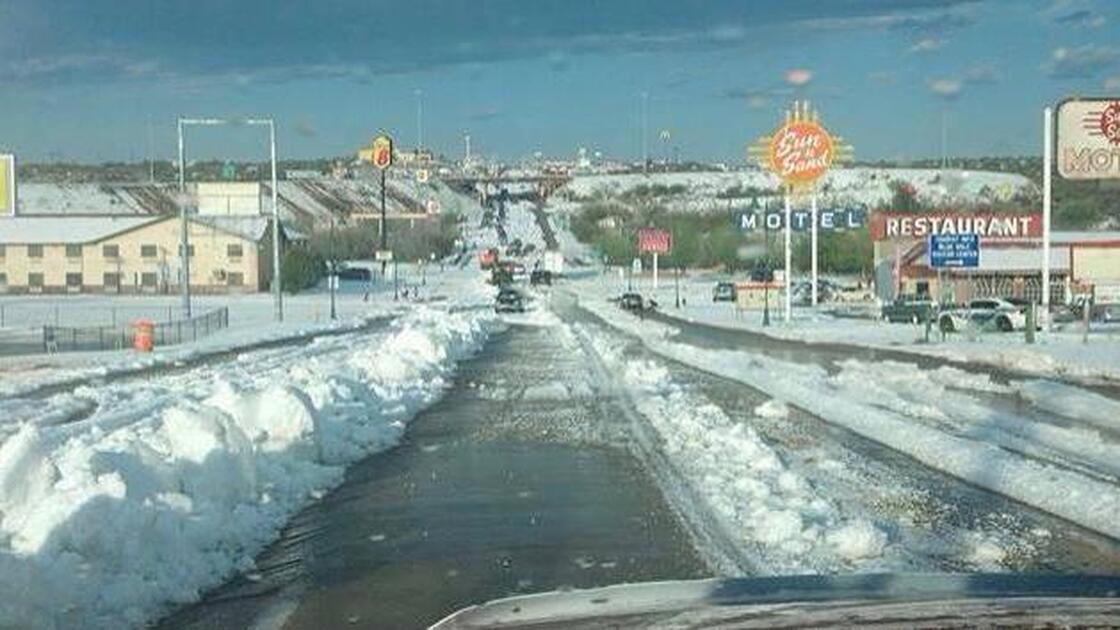
This event was predicted within the last ALTA webbot report.
Via theextinctionprotocol.wordpress.com, 6 July 2013 - NEW MEXICO - A storm dumped inches of hail on Santa Rosa Wednesday evening leaving a lot of ice and damage in its wake. The storm, which moved in from San Miguel County, lasted for about an hour. Thursday morning, Santa Rosa still looked like a winter wonderland from the air. Ice blanketed the streets, parks and rooftops on the Fourth of July, the morning after the storm that dumped 3-6 inches of nickel- to golf-ball-sized hail that accumulated to feet in depth in some places.
“It’s funny to see the people at Park Lake all in shorts and stuff and swimming trunks, and in the snow, it seems like,” Horacio Lopez said. Santa Rosa’s fire chief said while he appreciates the moisture during the long-running drought, the storm caused dangerous conditions on roadways. “Some people I talked to were stuck for five to six hours,” Chief Gilbert Romero said. “It’s just really bad, something I’ve never seen in my 50 years of life. I’ve never seen anything like this.” Some of the original stained glass windows, dating back about 100 years, at St. Rose of Lima Catholic Church were damaged by the hail. Resulting water damage also forced businesses to close including the Family Dollar as people continued to shovel hail off of roofs. “We’ve just spent the morning here trying to assess our damage,” Mario Trujillo, the owner of the Sun & Sand Restaurant, said. “Just looking at town, it’s just incredible.
We’ve heard of carports falling.” Roberta Blea didn’t realize her carport had fallen on all three of her family’s cars until after the storm passed. She said the falling hail was so loud, they couldn’t hear the carport collapsing. “I looked out and it was just raining hail,” Blea told KRQE News 13. “I had never seen that happen. I just never even expected this much destruction. It’s devastating.” Forecasters with the National Weather Service said these types of hail storms aren’t uncommon, but that it’s rare for this to happen before monsoon season starts. - –KRQE
TABER, ALBERTA: “There’s still hail sitting around now and it’s like what, noon?” said Gaylene Whitley, surveying her lawn. “It’s still sitting around. It came down in buckets.” For Taber residents, waking up to snow on the lawn is normal in the spring.
But waking to snowdrifts in July has the town speechless. Friday evening, large thunderstorms rolled into Taber, with hail covering streets, lawns and sidewalks. Ice pellets blocked storm sewers, flooding residential streets and sending some vehicles floating in the water. “In some spots in town I bet you there was two feet of water on the road. It was a lot of water and hail,” said Taber resident Cody Cook. Taber RCMP say there were no reports of anyone injured, or any major damage to property during the storm. Residents are left with lawns full of mud and leaves, and of course, piles of snow. But five blocks away from these homes, there’s no evidence of a storm at all. Residents in the North end of Taber seem to have been hit the hardest.
One home owner said his roof is newly re-shingled, but that didn’t stop the water from coming in. “There’s water pouring in my parent’s house. Through the roof, through the walls, through the light fixtures,” said Cook. Residents say in some areas, water came up to car bumpers. Vehicles stalled trying to break through the hail filled streets, which are now filled with people from the South end of town catching a glimpse of the destruction five minutes away. All streets in Taber are now clear of water, as well as tree branches broken in the storm. –Global News
A very interesting subject title when thinking about the Global Coastal Event predicted language. This article is a look back on the recent flooding in India which caused thousands to go missing which are possibly dead and hundreds of villages to be wiped out.
LACHMOLI, India — Ninety-year-old Sarita’s sunken eyes stared into the damp earth that had flooded into the terrace of her one bedroom house. Her two grandchildren played nearby in the mud.
Sarita’s only son had gone to the Kedar valley to work during the busy pilgrimage season. Two weeks after the disaster, she had no news from him. Lachmoli had been cut off. Only a small dirt footpath enabled residents to trek to safety and seek supplies. Her daughter-in-law had passed away a few years earlier, potentially making this frail, wrinkled elder the family’s only remaining adult.
“Who will take care of [the children]?” she mumbled as we distributed food to the children. “I don’t know if my son is alive or dead.”
Throngs of villagers remain uncertain of their loved ones’ fate, after the June 16 flashfloods killed nearly 1,000 people and left 3,500 missing here in Uttarakhand state, near the Nepal border. The disaster prompted a major air rescue operation, with the Indian Army evacuating more than 100,000 people from Himalayan valleys.
Resulting from the heaviest rains in 80 years, the floodwaters wrecked more than 150 bridges and close to 1,500 roads in the state, according to official figures, leaving villages like Lachmoli inaccessible to relief efforts. Drinking water, electricity and communications were badly damaged. An estimated 658 villages remained in darkness two weeks after the disaster.
The response to the floods has highlighted the state's lack of preparedness, and underscored the urgent need for better infrastructure, coordination and communication between government bodies.
The Indian home ministry admitted the lapses and told a Parliamentary Committee last Monday that a national flood risk mitigation scheme had been rejected in January because it missed vital components.
A medical relief team of eight doctors and paramedics from New Delhi visited the area in late June. After lengthy negotiations, two soldiers agreed to take us to Rudraprayag, the town where the Alaknanda and Mandakini rivers meet. The roads were under repair and open only for a few hours.
As we traveled, rivers swollen by monsoon rains surged alongside, a reminder of the force that had swept away entire communities. It took four hours to navigate the 90-minute journey through the villages. Further uphill, the roads were completely gone.
In the villages of Devimanda and Mahar Gaon, on the banks of the river Alaknanda, the majority of households had washed away. Lacking electricity, with ruined homes and lost families, the few remaining residents bore an almost ghostly look. Tears swelled in their eyes as they told us how they saw loved ones and houses swept away in the angry river.
“It was like Lord Shiva was doing his Tandav” said one, talking of the Hindu god Shiva, or the Destroyer, who in Hindu mythology performs his divine dance to destroy a weary universe.
In the villages of Silani Gaon, Jagathi and Chamm, we listened to the complaints and needs of the people. Some felt ignored by local authorities and neglected by relief efforts.
Upon returning to Rudraprayag, we informed the authorities about the conditions in those villages. They said that they were doing their best with the limited resources they had, pointing to problems of access and communication. The biggest challenge, they said, was to deliver essentials — rations, clothes, fuel and chlorine tablets — to remote areas where people were stranded.
Some locals were helping stranded victims. Devprayag, a normally bustling town further downhill, was almost completely deserted. We met a few local shopkeepers, who told us how they had stockpiled food, water and other necessities, and kept their shops open past midnight to help people fleeing upper regions. They were aided by pharmacists making daily trips from Rishikesh and bringing much-needed medicines.
For the locals, the floods were more than just a natural disaster. A priest told us that the government had angered the Gods and brought this disaster upon the people. According to legend, he said, the Char Dham pilgrims were protected by Dhari Devi (an avatar of the Hindu goddess Kali Mata). However, the idol had been shifted from its original place in view of the Hydel Power Project.
“This angered the Devi and Lord Shiva, whose one form is Kedarnath, and a few hours later there was cloudburst and floods," he said. He added that a king in 1880’s had made a similar attempt, which with similar results. Many locals and religious leaders had strongly opposed the shifting of the idol.
Further downstream in the state capital of Dehradun, we met more patients rescued from the flood zones. Relatives clutched photographs of loved ones who were still missing without any news.
We were surprised to see that most of the patients had undergone amputations. The senior orthopedic surgeon said the patients had been forced to walk to safety with injuries that had eventually gotten infected, leading to the amputations. The make-shift medical camps in the flood-hit mountainous region lacked the facilities to take care of trauma cases.
One patient, 60-year-old Suhani Devi, who had planned the pilgrimage for years, suffered a serious infection after all of her diabetes medicines had been washed away. She had lost touch with her companions, and was concerned about their fate.
Aside from the injured, many residents had lost their livelihoods. The waters washed away the mules that twenty-year-old Kumar, had used to ferry pilgrims to and from the temples.Villagers showed resilience in the face of the calamity. They had risked their own lives to help each other.
The need for a better infrastructure and relief coordination was dire. Efficient communication systems, multi-purpose shelters with medicine and food, and prediction models to help authorities issue early warnings would have gone a long way in ensuring the safety of the survivors, and would have saved many lives, which are now in peril because these facilities are lacking.
Dr. Manpreet Bajwa reported from the flood zone, which she visited from June 26-30 as part of a medical relief team. Dr. Harmandeep Singh Boparai reported from New York.
Via navy.mil, 25 February 2013 - U.S. Naval Research Laboratory (NRL) research physicists and engineers from the Plasma Physics Division, working at the High-frequency Active Auroral Research Program (HAARP) transmitter facility, Gakona, Alaska, successfully produced a sustained high density plasma cloud in Earth's upper atmosphere. "Previous artificial plasma density clouds have lifetimes of only ten minutes or less," said Paul Bernhardt, Ph.D., NRL Space Use and Plasma Section.
Sequence of images of the glow plasma discharge produced with transmissions at the third electron gyro harmonic using the HAARP HF transmitter, Gakona, Alaska. The third harmonic artificial glow plasma clouds were obtained with HAARP using transmissions at 4.34 megahertz (MHz). The resonant frequency yielded green line (557.7 nanometer emission) with HF on November 12, 2012, between the times of 02:26:15 to 02:26:45 GMT. - See more at: http://www.nrl.navy.mil/media/news-releases/2013/nrl-scientists-produce-densest-artificial-ionospheric-plasma-clouds-using-haarp#sthash.Rh4opuze.dpuf
"This higher density plasma 'ball' was sustained over one hour by the HAARP transmissions and was extinguished only after termination of the HAARP radio beam." These glow discharges in the upper atmosphere were generated as a part of the Defense Advanced Research Projects Agency (DARPA) sponsored Basic Research on Ionospheric Characteristics and Effects (BRIOCHE) campaign to explore ionospheric phenomena and its impact on communications and space weather.
Using the 3.6-megawatt high-frequency (HF) HAARP transmitter, the plasma clouds, or balls of plasma, are being studied for use as artificial mirrors at altitudes 50 kilometers below the natural ionosphere and are to be used for reflection of HF radar and communications signals.
Past attempts to produce electron density enhancements have yielded densities of 4 x 10⁵ electrons per cubic centimeter (cm3) using HF radio transmissions near the second, third, and fourth harmonics of the electron cyclotron frequency. This frequency near 1.44 MHz is the rate that electrons gyrate around the Earth's magnetic field.
The NRL group succeeded in producing artificial plasma clouds with densities exceeding 9 x 10⁵ electrons cm3 using HAARP transmission at the sixth harmonic of the electron cyclotron frequency.
Optical images of the artificial plasma balls show that they are turbulent with dynamically changing density structures. Electrostatic waves generated by the HAARP radio transmissions are thought to be responsible for accelerating electrons to high enough energy to produce the glow discharge in the neutral atmosphere approaching altitudes of nearly 170 kilometers.
The artificial plasma clouds are detected with HF radio soundings and backscatter, ultrahigh frequency (UHF) radar backscatter, and optical imaging systems. Ground measurements of stimulated electromagnetic emissions provide evidence of the strength and frequency for the electrostatic waves that accelerated ambient electrons to ionizing velocities.
The NRL team is working with collaborators at SRI International, University of Alaska Fairbanks, University of Florida, and BAE Systems on this project to synthesize the observations with parametric interactions theory to develop a comprehensive theory of the plasma cloud generation. The next HAARP campaign, scheduled for early 2013, will include experiments to develop denser, more stable ionization clouds.
June 26, 2013 - MADAGASCAR - Madagascar is in the grips of a largely uncontrolled locust plague and risks a serious food crisis. A large-scale emergency control campaign urgently requires a minimum of $22 million in funding to start in time for the next crop planting season in September. So far, FAO emergency appeals for Madagascar remain severely underfunded.
By September, FAO expects that two-thirds of the country will be infested by locusts.
Some 13 million people’s food security and livelihoods are at stake, or nearly 60 percent of the island’s total population. Nine million of those people are directly dependent on agriculture for food and income. Sounding the alarm – more loudly FAO has issued various warnings since August 2012 calling for financial support.
FAO Director-General José Graziano da Silva emphasized that prevention and early action are key. “If we don’t act now, the plague could last years and cost hundreds of millions of dollars. This could very well be a last window of opportunity to avert an extended crisis,” he said.
Timely control of the locust upsurge in Madagascar at an early stage would have cost $ 14.5 million in 2011-1012, but FAO only received half the funding necessary. Another campaign had to be launched, but that received barely a quarter of the required funds in 2011/2012.
When the Sahel region experienced a locust upsurge in 2003-2005, the costs of control operations exceeded $ 570 million, in addition to the economic damages in terms of lost crops and food aid.
Preventive control measures normally cost $3.3 million per year for the 10 affected Sahelian countries. So intervening only when the situation reaches a crisis point cost roughly the same as 170 years of prevention.
In order to have all the supplies and personnel in place to mount a wide-scale anti-locust campaign starting in September, funding should be allocated by July.
FAO’s locust control programme needs to be fully funded in order to monitor the locust situation throughout the whole contaminated area and to carry out well-targeted aerial control operations. Otherwise, undetected or uncontrolled locust populations will continue to breed and produce more swarms.
The plague would therefore last several years, controlling it will be lengthier and more expensive and it will severely affect food security, nutrition and livelihoods.
The complete three-year programme, which is needed to return the locust plague to a recession, requires more than $41.5 million over the next three years.
According to a recent FAO assessment mission on the impact of the current locust plague in Madagascar, in parts of the country rice and maize losses due to the locusts vary from 40 to 70 percent of the crop, with 100 percent losses on certain plots.
A joint Crop and Food Security Assessment Mission, supported by FAO, IFAD and WFP and in close cooperation with the Malagasy Government, is currently on the ground to measure the locust plague’s damages to food security and livelihoods. More detailed data analysis will be available in July, but the resources to start preparation for the field actions have to be available now. Major impact on food securityAccording to FAO estimates, there could be losses in rice production of up to 630 000 tonnes, or about 25 percent of total demand for rice in Madagascar. This would severely affect food and nutrition security and livelihoods of the most vulnerable.
Rice is the main staple in the country, where 80 percent of the population lives on less than a dollar per day. One and a half million hectares will need to be treated by aerial spraying during the 2013/2014 campaign. The three-year FAO programme includes:
improving the monitoring and analysis of the locust situation;
large-scale aerial and ground spraying and related training;
monitoring and mitigating the effect of control operations on health and the environment;
measuring the impact of anti-locust campaigns and the damages to crops and pasture.
Via NBC News, 5 July 2013 - Four U.S. airlines temporarily suspended flights to and from Mexico City on Thursday after a volcano 50 miles from the capital spewed ash, a spokesman for the city's international airport said.
Three to eight flights on American Airlines, U.S. Airways, Delta Air Lines and Alaska Air Group have been postponed so far, Richard Jimenez, a representative for Mexico City's international airport told Reuters. "The decision not to fly from Mexico City has been made by these airlines, but the airport is in operable conditions," Andres Gomez, another airport representative, said on local television. No Mexican airlines have halted operations, Gomez said.
Mexico's leading airline AeroMexico suspended flights briefly Thursday morning, but resumed operations less than an hour later.
The volcano Popocatepetl in the central state of Puebla has been more active this year, prompting officials to raise warning levels but have so far ordered no evacuations.
Officials have kept the volcano's risk level on hold at "yellow," the second highest on the four-color spectrum, indicating that there is more activity than usual but no threat of eruption, national emergency services coordinator Luis Felipe said on Twitter.
On Thursday, ash fell on communities adjacent to the volcano, nicknamed Don Goyo, and reached southern neighborhoods of Mexico City.
There is no evidence of volcanic ash in the airport's immediate vicinity, it announced through its Twitter account. Volcanic ash can damage jet engines.
Mexico City's airport serves more than 29 million people a year and oversaw 174,511 takeoffs and landings between January and June.
"Speak to the Israelites and say to them: 'When you
enter the land I am going to give you and you reap its harvest, bring to the
priest a sheaf of the first grain you harvest.
He is to wave the sheaf before the LORD so it will be
accepted on your behalf; the priest is to wave it on the day after the Sabbath.
On the day you wave the sheaf, you must sacrifice as a
burnt offering to the LORD a lamb a year old without defect.
3500 ago, God set up Israelite Law through Moses that Israelites should return to Jerusalem every year in Spring Festival to observe
Passover. Observing the
Passover comprises of three festivals
including the Passover, the Feast of Unleavened Bread and
the Festival of First Fruits.
During the Festival of First Fruits, the Israelites need to offer the first harvest, the first
grain of harvest as a wave offering to God.
So since the ancient time, the sacrifice that pleases God should be the ripe fruits
or the crops full of grains.
As a result, about 2000 years ago, Jesus was born. When Jesus was 33 years old, he became the Passover
lamb according to the law of the
Passover in spring time. He fulfilled God’s plan of redemption with many holy ones raising from their tombs. Besides, during the Festival of First Fruits, Jesus also
raised from the dead with his earthly body. He is
the first one
who acquired the Body of Resurrection, and together he brought with
him a group of holy ones who also are resurrected, mature in their faith and mission in life. With the Body of Resurrection, they got up to the Throne of God and
became the first
grain of the wave offering.
Matthew 27:50-53:
And when Jesus had cried out again in a loud voice, he
gave up his spirit.
At that moment the curtain of the temple was torn in two
from top to bottom. The earth shook and the rocks split.
The tombs broke open and the bodies of many holy people
who had died were raised to life.
They came out of the tombs, and after Jesus' resurrection
they went into the holy city and appeared to many people.
So, in 1 Corinthians chapter 15, Apostle Paul revealedthat in
the last days, the holy ones will be like Jesus, with physical change that they can have the Body of Resurrection.
1 Corinthians 15:20-25:
But Christ has indeed been raised from the dead, the
firstfruits of those who have fallen asleep.
For since death came through a man, the resurrection of
the dead comes also through a man.
For as in Adam all die, so in Christ all will be made
alive.
But each in his own turn: Christ, the firstfruits; then,
when he comes, those who belong to him.
Then the end will come, when he hands over the kingdom to
God the Father after he has destroyed all dominion, authority and power. For he
must reign until he has put all his enemies under his feet.
Besides, in Philippianschapter 3, Apostle Paul also stated
that Jesus has the Body of Resurrection, which is the model for the saints in the last days, as the first Fruits.
Philippians 3: 21:
Who, by the
power that enables him to bring everything under his control, will transform
our lowly bodies so that they will be like his glorious body.
Similarly, Apostle Paul stated that again that in the last days when the horns blow just how the Israelites used to blow in every year’s Feast of Trumpets, the saints will experience
what Jesus had experience and will have the Body of Resurrection. They can even get up to heaven escaping
the Seven Years of Tribulation on earth.
1 Corinthians 15:50-53:
I declare to you, brothers, that flesh and blood cannot
inherit the kingdom
of God, nor does the
perishable inherit the imperishable.
Listen, I tell you a mystery: We will not all sleep, but
we will all be changed--
in a flash, in the twinkling of an eye, at the last
trumpet. For the trumpet will sound, the dead will be raised imperishable, and
we will be changed.
For the perishable must clothe itself with the
imperishable, and the mortal with immortality.
Thus, before the disasters at the endtime, the church and the saints
will be like Jesus, that they may become the ripe fruits or the crops full
of grains. It means that during their life on earth, they are
just like the wheat of the
Festival of First Fruit, which
they fill up their inner, and satisfy their destiny and the duties as a
Christians, so as to become
the first
grain of harvest that God pleased.
Moreover, in the last days, during the harvest of the Feast of Tabernacles in
Autumn Festival, not only do some churches become the wheat, but also
have the fruits of the Holy Spirit. Just like the life of Joseph, he was always watchful even
under the most difficult
situation that
he even completed the duty of his belief that
given to him. He
got ready for the Seven Years of
Famine. Besides, he even helped the people around him, such as his brothers and father that he provided the answer and solution for
the disaster.
So, in the last days, the churches and the saints can follow
Joseph’s belief, and
fulfill the mission given by God. They
can become the sacrifices that God pleased,
thus get up to heaven before Seven
Years of Tribulation. Just like Jesus, they can have
the Body of Resurrection and
escape from the disasters on earth.
So, the
Revival is going to happen in the last days. According to the acoustic
frequency creation, some new believers are always
watchful just like the wheat being
filled up inside speedily. Thus they become the sacrifice of the first grain that God pleased.
Amos 9:13:
"The
days are coming," declares the LORD, "when the reaper will be
overtaken by the plowman and the planter by the one treading grapes. New wine
will drip from the mountains and flow from all the hills.
So, in the last days, in the wedding of
the Lamb in heaven, other than Jesus, the Bible tells us that there are three
groups of people.
1. The bride:
They are the church which know about the
coming of Jesus and always be watchful and get ready. They
observe the rehearsal of the Holy Communion and wait for the coming of Jesus. They
even complete the Revival
in the last days.
2. The Watchful Virgins
They do not sleep like other virgins, who delay in
participating in the
wedding of the Lamb.
3.
The Guests who get ready.
Although
they cannot be like the brides and the virgins to fulfill many of the missions of the Kingdom of God, still they catch up. And like the wheat that
fill up their inner, and
get ready to complete the basic duty of one’s belief, they still become the sacrifice that God pleased.
Matthew 22:2-10
The kingdom of heaven is like a certain king, who made a
feast when his son was married
And sent out his servants to get in the guests to
the feast: and they would not come
Again he sent out other servants, with orders to
say to the guests, See, I have made ready my feast: my oxen and my fat beasts
have been put to death, and all things are ready: come to the feast
But they gave no attention, and went about their
business, one to his farm, another to his trade
And the rest put violent hands on his servants,
and did evil to them, and put them to death
But the king was angry; and he sent his armies,
and those who had put his servants to death he gave to destruction, burning
down their town with fire
Then he said to his servants, The feast is ready
but the guests were not good enough.
Go then to the cross-roads, and get all those
whom you see to come to the bride-feast And those servants went out into the streets, and
got together all those whom they came across, bad and good: and the feast was
full of guests
However, in the great revival in the end, some people - because of
backsliding and pleasure seeking in
terms of their faith - will not prepare well. They
finally can’t be taken up to the lamb’s wedding.
Matthew 22:11-14
But when the king came in to see the guests, he
saw there a man who had not on a guest's robe
And he says to him, Friend, how came you in here
not having a guest's robe? And he had nothing to say
Then the king said to the servants, Put cords
round his hands and feet and put him out into the dark; there will be weeping
and cries of sorrow
For out of all to whom the good news has come,
only a small number will get salvation.
If a person’s faith is unlike wheat fully filled up,
God will not take him as an offering.
In addition, he is easily swept away by the wind due to inner hollowness and left in the outside darkness.
Psalms 1:4 The evil-doers are not so; but are like the dust
from the grain, which the wind takes away.
Similarly, Jesus has demonstrated when
he was resurrected and taken up to heaven, he was only going
with those saints already passed away, act as the first fruit of the wave
offering to God. It was because his
disciples just woke up from the situation of knowing God, they had failed to
fulfill the responsibility in their own beliefs.
On the other hand, Revelation Chapter 14 says, God has chosen a
hundred and forty-four thousand people to preach his gospel in the
disaster. They need to be the first
fruits to God as well.
Revelation 14:1-4
And I saw the Lamb on the mountain of Zion, and
with him a hundred and forty-four thousand, marked on their brows with his name
and the name of his Father
And a voice from heaven came to my ears, like the
sound of great waters, and the sound of loud thunder: and the voice which came
to me was like the sound of players, playing on instruments of music
And they made as it seemed a new song before the
high seat, and before the four beasts and the rulers: and no man might have
knowledge of the song but the hundred and forty-four thousand, even those from
the earth whom God has made his for a price These are they who have not made themselves
unclean with women; for they are virgins. These are they who go after the Lamb
wherever he goes. These were taken from among men to be the first fruits to God
and to the Lamb
So no matter the rapture is before the disaster or in the midst, or even in the end, we
must fulfill God’s requirement, to have a resurrected body into eternality. We
must aim at
becoming the first fruits to God, fill up ourselves with Christ character, complete our
responsibility in faith and be the first-fruit that is God pleased. As wrote by Apostle Paul near the end of his
life.
June 26, 2013 - UNITED STATES - An investigation is underway to learn why a greater-than-normal number of fish for this time of year are washing up on shore around Canandaigua Lake.
Dead fish are washing ashore on the north end of Canandaigua Lake but on Monday it wasn't keeping people such as these playing with their dog at the small boat launch out of the water. Jack Haley/Messenger Post Media
During spawning season it is typical to find dead fish washing up due to various stresses fish experience, such as in defending their turf and dealing with a rapid increase in temperature, said Canandaigua Lake Watershed Manager Kevin Olvany.
"The usual suspects" in Olvany's words are smaller fish like perch and sunfish. This season, he said, there appears to be a greater quantity of fish washing up of all varieties, which include larger fish — such as large bass. The situation warranted an investigation, Olvany said.
A recently deceased Sunfish washes ashore at the small boat launch at the north end of Canandaigua Lake. Jack Haley/Messenger Post Media
A large fish washes up amonngst the large rocks on the north shore of Canandaigua Lake at Kershaw Park. Jack Haley/Messenger Post Media
Over a dozen fish lay dead along with some garbage on the north shore of Canandaigua Lake along Kershaw Park. Jack Haley/Messenger Post Media
Olvany was at Kershaw Park in Canandaigua on Monday looking over the situation, and he said other sections of the lake also appear to have more fish washing up. A fish sample has been sent to the state Department of Environmental Conservation for testing and results should be back soon, he said.
The DEC is having the fish tested for viral hemorrhagic septicemia (VHS) virus. A serious pathogen of fresh and saltwater fish, the rod-shaped virus affects fish of all size and age ranges. It does not pose any threat to human health, according to the DEC. The virus is causing a disease issue in the Great Lakes region of the United States and Canada; it can cause hemorrhaging of fish tissue, including internal organs, and can cause the death of infected fish, the DEC says. Once a fish is infected with VHS, there is no known cure.
Olvany said that even if the first test comes back negative for the virus, there will be further testing to confirm that. The virus was found in fish in Irondequoit Bay in May, Olvany said.
Paula Larivee, who walks regularly along Kershaw Park, said she was disturbed to see the number of big, dead fish — 12 inches or longer, she said — during a walk Sunday.
“When you walk there several days a week, you notice changes in the lake,” said Larivee. “This was alarming.” - MPN Now.